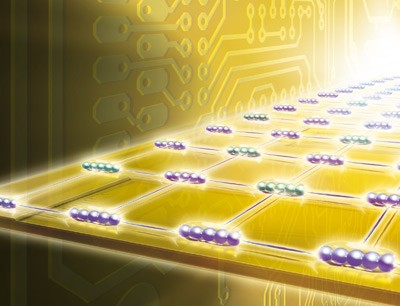
Quantum antennae enable the exchange of quantum information between two separate memory cells located on a computer chip. (Graphics: Harald Ritsch)
The Austrian research group led by physicist Rainer Blatt suggests a fundamentally novel architecture for quantum computation. They have experimentally demonstrated quantum antennae, which enable the exchange of quantum information between two separate memory cells located on a computer chip. This offers new opportunities to build practical quantum computers. Photo: Quantum antennae enable the exchange of quantum information between two separate memory cells located on a computer chip. (Graphics: Harald Ritsch) - Six years ago scientists at the University of Innsbruck realized the first quantum byte - a quantum computer with eight entangled quantum particles; a record that still stands. "Nevertheless, to make practical use of a quantum computer that performs calculations, we need a lot more quantum bits," says Prof. Rainer Blatt, who, with his research team at the Institute for Experimental Physics, created the first quantum byte in an electromagnetic ion trap. "In these traps we cannot string together large numbers of ions and control them simultaneously." To solve this problem, the scientists have started to design a quantum computer based on a system of many small registers, which have to be linked.
UM DIESEN ARTIKEL ZU LESEN, ERSTELLEN SIE IHR KONTO
Und verlängern Sie Ihre Lektüre, kostenlos und unverbindlich.