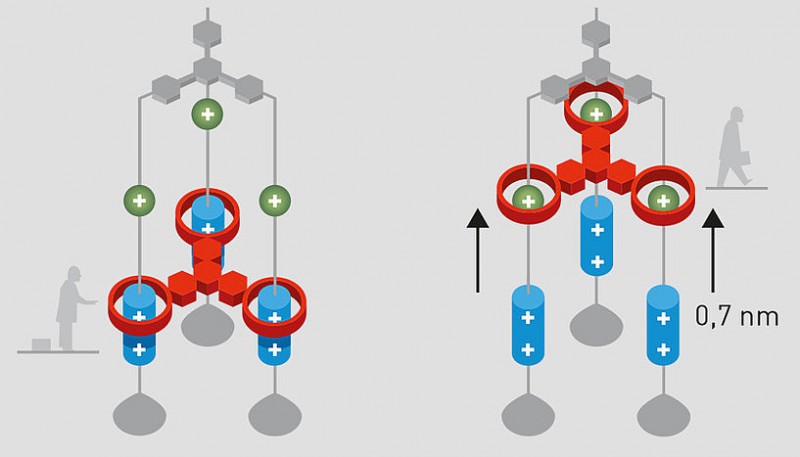
A tiny lift, artificial muscles and miniscule motors: The 2016 Nobel Laureates in Chemistry have miniaturised machines and taken chemistry to a new dimension. (Illustration: Johan Jarnestad/The Royal Swedish Academy of Sciences)
uni:view magazin Videos Presse Social Media - The Nobel Prize in Chemistry 2016 has been awarded to Jean-Pierre Sauvage, Sir Fraser J. Stoddart and Bernard L. Feringa for the design and synthesis of molecular machines. Freddy Kleitz, chemist at the University of Vienna, illustrates the relevance of this research area. The achievements of the three scientists stem from the area of chemistry known as supramolecular chemistry (a term proposed by Jean-Marie Lehn, Nobel in 1987) and they branch into nanoscience and nanotechnology. Supramolecular chemistry has initially been defined as "the chemistry of the noncovalent bond". On the other hand, nanoscience is defined as the science that studies the properties of matter that has at least one dimension of the order of a billionth of a meter (1 x 10⁻⁹), i.e., a nano-meter. Nanotechnology refers then to the development of applications based on nanoscience. About the author: - Freddy Kleitz is Professor of Inorganic Chemistry and head of the Department of Inorganic Chemistry - functional Materials at the Faculty of Chemistry of the University of Vienna.
UM DIESEN ARTIKEL ZU LESEN, ERSTELLEN SIE IHR KONTO
Und verlängern Sie Ihre Lektüre, kostenlos und unverbindlich.