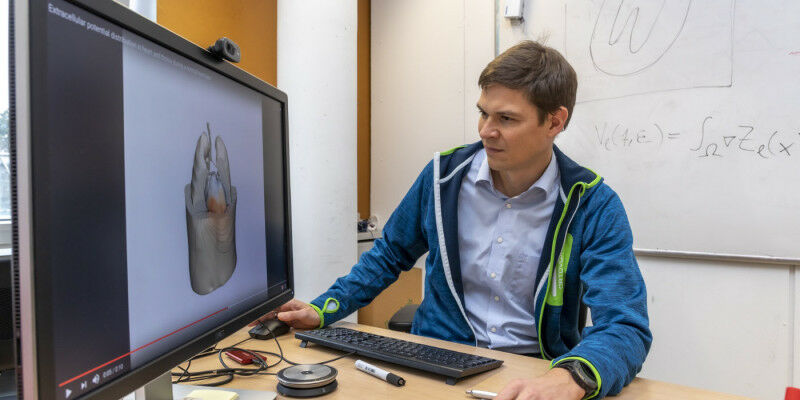
In the CardioTwin project, Thomas Pock wants to take additional variables into account when reconstructing the heart activation sequence and at the same time speed up the simulations. Image source: Lunghammer - TU Graz
In the CardioTwin project, Thomas Pock wants to take additional variables into account when reconstructing the heart activation sequence and at the same time speed up the simulations. Image source: Lunghammer - TU Graz - In this interview, Thomas Pock from the Institute of Computer Graphics and Vision explains what determining the activation sequence of the heartbeat has in common with throwing stones into a lake and how this can soon be learned in a personalised way using ECG data. How can you make a digital twin of the heart?. Thomas Pock: We developed a digital twin of the heart over the past few years as part of a BioTechMed cooperation project led by Gernot Plank from the Medical University of Graz. First, you need a digital image of the anatomy of the heart that is to be simulated. Every person's heart is unique, varying in size and shape, and the anatomy of pathological hearts sometimes is severely altered. This image is created utilising computer tomography and magnetic resonance images.
UM DIESEN ARTIKEL ZU LESEN, ERSTELLEN SIE IHR KONTO
Und verlängern Sie Ihre Lektüre, kostenlos und unverbindlich.