


news 2018
Categories
Years
2009 | 2010 | 2011 | 2012 | 2013 | 2014 | 2015 | 2016 | 2017 | 2018 | 2019 | 2020 | 2021 | 2022 | 2023 | 2024 | 2025 | 2026 |
2009 | 2010 | 2011 | 2012 | 2013 | 2014 | 2015 | 2016 | 2017 | 2018 | 2019 | 2020 | 2021 | 2022 | 2023 | 2024 | 2025 | 2026 |
Results 81 - 100 of 104.
Chemistry - Mathematics - 26.03.2018

TU Wien and Sandoz GmbH have successfully implemented a real-time computer simulation of the complex growth behaviour of penicillin producing organisms. This simulation now helps to keep the production process under control. For thousands of years, micro-organisms have been used to facilitate chemical reactions - in beer brewing, for example.
Innovation - Electroengineering - 22.03.2018

By Julian Naderer How to build the world's most efficient vehicle? What materials are suitable? Is electromobility the mobility of the future? In the TERA team we deal with all these TERA TU Graz is a student team that develops energy-efficient vehicles. We are students of various Graz universities, and we work together because we want to educate ourselves further and because we want to help shape the future of mobility.
Physics - 19.03.2018

Combining two ultra-thin material layers yields new possibilities for quantum electronics. A research team with members from TU Wien presents strongly tunable quantum systems. Two novel materials, each composed of a single atomic layer and the tip of a scanning tunneling microscope - these are the ingredients to create a novel kind of a so-called "quantum dot".
Computer Science - 12.03.2018

Graphics processing units (GPUs) are used for many computationally intensive tasks. Their aging process can be slowed by clever management, as TU Wien (Vienna) and University of California (Irvine) have now shown. Graphics processing units are not only used for displaying graphics. Today, they are frequently used for particularly challenging calculations - for example in scientific research or even Bitcoin-mining.
Physics - 06.03.2018

An Innsbruck team of experimental physicists, in collaboration with theorists from Innsbruck and Hannover, has for the first time observed so-called roton quasiparticles in a quantum gas. Empirically introduced by Landau to explain the bizarre properties of superfluid liquid Helium, these quasiparticles reflect an "energy softening" in the system as precursor of a crystallization instability.
Physics - Chemistry - 06.03.2018

How do you combine different elements in a crystal? At TU Wien, a method has now been developed for incorporating previously unattainably high proportions of foreign atoms into crystals. When you bake a cake, you can combine the ingredients in almost any proportions, and they will still always be able to mix together.
Environment - Life Sciences - 26.02.2018
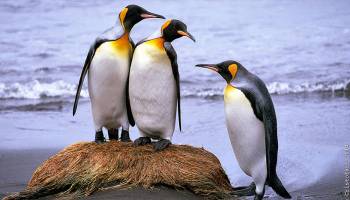
More than 70 percent of the global King penguin population, currently forming colonies in Crozet, Kerguelen and Marion sub-Antarctic islands, may be nothing more than a memory in a matter of decades, as global warming will soon force the birds to move south, or disappear. This is the conclusion of a study published in the current issue of the prestigious and performed by an international team of researchers from France, Monaco, Italy, Norway, South Africa, Austria and US.
Physics - Chemistry - 26.02.2018

Scientists from TU Wien (Vienna, Austria) and the USA have provided proof for a new state of matter: an electron orbits a nucleus at a great distance, while many other atoms are bound inside the orbit. The electron (blue) orbits the nucleus (red) - and its orbit encloses many other atoms of the Bose-Einstein-condensate (green).
Life Sciences - Health - 22.02.2018

Writing in Water Research, researchers from TU Graz and the University of Graz discuss new materials that prevent damage from microbial induced concrete corrosion. More pictures available at the end of the text Wastewater systems are integral to infrastructure in every community. In an ideal world, they operate smoothly and are long-lasting.
Civil Engineering - 19.02.2018

Bridges change shape, which is why they are usually built with expansion joints. At TU Wien, a technology has been developed that makes it possible to forego these joints, thus saving time and money. You can feel it straight away when you drive over a bridge quickly: the expansion joint that you rumble over at the start and end of the bridge.
Physics - Computer Science - 15.02.2018

Quantum entanglement is a key feature of a quantum computer. Yet, how can we verify that a quantum computer indeed incorporates a large-scale entanglement? Using conventional methods is hard since they require a large number of repeated measurements. Aleksandra Dimić from the University of Belgrade and Borivoje Dakić from the Austrian Academy of Sciences and the University of Vienna have developed a novel method where in many cases even a single experimental run suffices to prove the presence of entanglement.
Physics - Chemistry - 13.02.2018

Storing information in a quantum memory system is a difficult challenge, as the data is usually quickly lost. At TU Wien, ultra-long storage times have now been achieved using tiny diamonds. At some locations in the crystal lattice, a carbon atom (white) is missing, and at the neighbouring site there is a nitrogen atom (yellow).
Chemistry - Physics - 12.02.2018

Spectacular electron microscope images at TU Wien lead to important findings: Chemical reactions can produce spiral-like multi-frequency waves and thus provide local information about catalysts. They appear almost hypnotic, like a lava lamp. The waves made visible at TU Wien using a photoemission electron microscope cover the surface of rhodium foil with bizarre patterns which dance around on the surface.
Environment - 08.02.2018
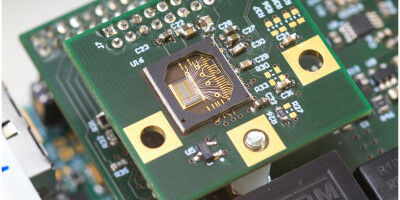
By Birgit Baustädter Alexander Bergmann and his team at TU Graz's Institute of Electronic Sensor Systems have made it their aim to improve our quality of air and life by means of sophisticated sensor systems. It's a radiantly beautiful day as Alexander Bergmann talks about his research area in his Graz Inffeldgasse office, which is bathed in light.
Physics - Mechanical Engineering - 07.02.2018

Researchers succeed in controlling multiple quantum interactions in a realistic material Materials with controllable quantum mechanical properties are of great importance for the electronics and quantum computers of the future.
Physics - 07.02.2018

Stresses and strains can drastically alter the properties of a material, and TU Wien has now developed a method to make these internal deformations visible. Two-dimensional materials such as graphene, which consist of only one or a few atomic layers, have been a very promising aspect of materials science over recent years.
Campus - Materials Science - 06.02.2018

By Birgit Baustädter In the last four years, 14 young scientists worked in the field of advanced materials across Europe in the training network Thinface and are now completing their cross-border doctoral degrees. Joint research and international collaboration are the main cornerstones on which the work which is intensively promoted by TU Graz is built.
Earth Sciences - 30.01.2018

Mud stories provide new insights in the seismic hazard along the Chilean subduction zone By analyzing sediment cores from Chilean lakes, an international team of scientists discovered that giant earthquakes reoccur with relatively regular intervals. When also taking into account smaller earthquakes, the repeat interval becomes increasingly more irregular to a level where earthquakes happen randomly in time.
Philosophy - Mathematics - 29.01.2018

Can we teach ethical behaviour to machines' Computer Scientists in Vienna are studying ancient Sanskrit texts and using the tools of mathematical logic to describe ethical rules. The Indian sacred texts of the Vedas have been studied for millennia. But now, for the first time in history, computer scientists in Vienna analyse them by applying the methods of mathematical logic.
Physics - Innovation - 22.01.2018

TU Wien can now produce porous structures in monocrystalline silicon carbide. This opens up new possibilities for the realization of micro-and nanomachined sensors and electronic components, but also for integrated optical mirror elements to filter certain colours. Extremely fine porous structures with tiny holes - resembling a kind of sponge at nano level - can be generated in semiconductors.


