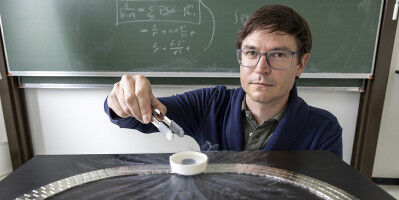
A cigar-shaped gas of magnetic atoms can support a roton mode: a modulation in the atom spatial organization at a given wavelength, forming a saddle on the energy mountain ridge of its elementary excitations. Fotonachweis: IQOQI Innsbruck/Harald Ritsch
An Innsbruck team of experimental physicists, in collaboration with theorists from Innsbruck and Hannover, has for the first time observed so-called roton quasiparticles in a quantum gas. Empirically introduced by Landau to explain the bizarre properties of superfluid liquid Helium, these quasiparticles reflect an "energy softening" in the system as precursor of a crystallization instability. The new work published demonstrate similar phenomena in the quantum-gas phase thanks to magnetic interactions, paving the way for a novel understanding of paradigmatic states of quantum fluids, such as supersolids. Discovered in liquid helium about 80 years ago, superfluidity is a counterintuitive phenomenon, in which quantum physics and particle-wave duality manifest at the macroscopic level. Since then, it has yielded many advances in understanding quantum matter, yet leaving mysterious some of its features. A hallmark of superfluidity is the existence of so-called "quasi-particles", i.e. elementary excitations dressed by interactions. The behavior of such a special fluid is mainly dictated by two types of excitations at low temperature, as their moderate energy cost allows to easily excite them.
UM DIESEN ARTIKEL ZU LESEN, ERSTELLEN SIE IHR KONTO
Und verlängern Sie Ihre Lektüre, kostenlos und unverbindlich.