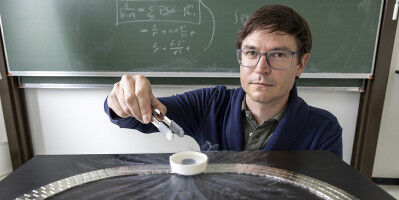
Das Team: Michele Reticcioli (Universität Wien), Jan Hulva, Ulrike Diebold, Martin Setvin, Michael Schmid (alle TU Wien), v.l.n.r.
When a crystal is broken along certain directions the atoms reorganize in amazing ways. Researchers in Vienna have watched this happen, and have learned to control it. Das Team: Michele Reticcioli (Universität Wien), Jan Hulva, Ulrike Diebold, Martin Setvin, Michael Schmid (alle TU Wien), v.l.n.r. The remarkable strength of ionic crystals is easily explained at the atomic scale: Positively and negatively charged atoms sit side by side in a periodic arrangement that repeats countless times. The strong electrostatic force in between keeps them together. But what happens when the periodic pattern comes to an abrupt end? Researchers at the Vienna University of Technology have carefully broken potassium tantalate crystals in specific directions, and imaged the resulting surfaces using a state of the art atomic force microscope. Their data was combined with computations performed at the University of Vienna, and a series of remarkable phenomena were ultimately explained.
UM DIESEN ARTIKEL ZU LESEN, ERSTELLEN SIE IHR KONTO
Und verlängern Sie Ihre Lektüre, kostenlos und unverbindlich.