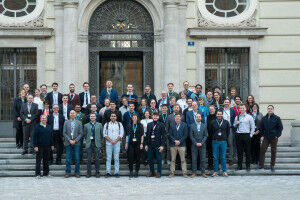
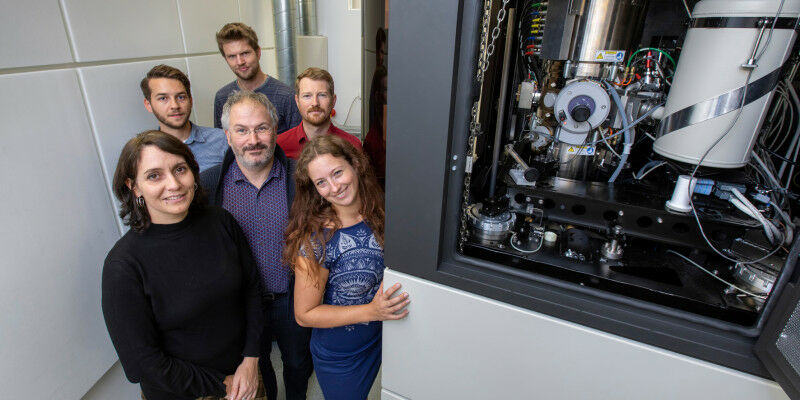
 Gerald Kothleitner (centre) and his research team consisting of Maria Poletti and Angelina Orthacker (1st row, from left to right) as well as Johannes Tändl, Georg Haberfehlner and Bernhard Sonderegger (back, from left to right) describe for the first time those atomic processes that lead to the formation of more powerful alloy materials with the help of the Austrian Scanning Transmission Electron Microscope (ASTEM);
Research team at TU Graz discovers atomic-level processes which can provide new approaches to improving material properties. Aluminium alloys have unique material properties and are indispensable materials in aircraft manufacturing and space technology. With the help of high-resolution electron tomography, researchers at TU Graz have for the first time been able to decode mechanisms crucial for understanding these properties. The research results have recently been published in Nature Materials. Nano structures responsible for material quality. Alloy elements such as scandium and zircon are added to the aluminium matrix to improve the strength, corrosion resistance and weldability of aluminium alloys. After further treatment, tiny roundish particles only a few nanometres in size, so-called nano-precipitates, are formed.
UM DIESEN ARTIKEL ZU LESEN, ERSTELLEN SIE IHR KONTO
Und verlängern Sie Ihre Lektüre, kostenlos und unverbindlich.
Ihre Vorteile
- Zugang zu allen Inhalten
- Erhalten Sie Newsmails für Neuigkeiten und Jobs
- Anzeigen veröffentlichen