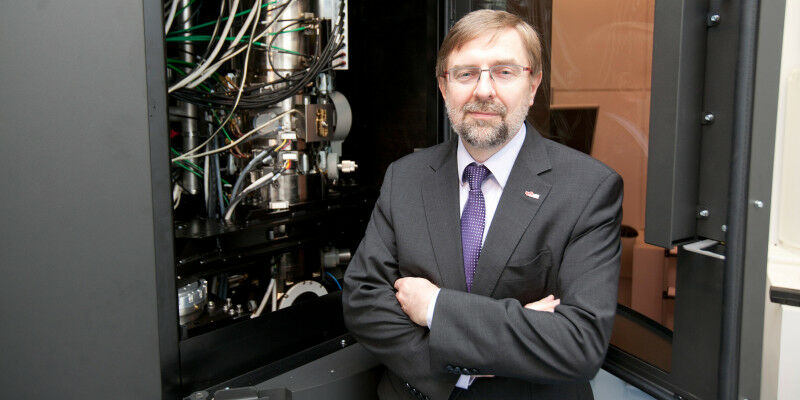
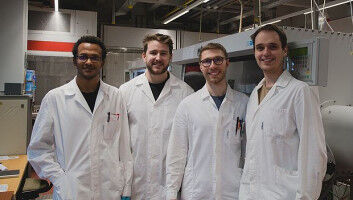
Ferdinand Hofer next to the ASTEM.
Round about 65 years ago, the first electron microscope was set up at TU Graz, thus laying a foundation stone for many years of successful research work. In 1951, the first electron microscope - the UEM 100 from Siemens & Halske - was set up in Styria in the then recently established Research Centre for Electron Microscopy at TU Graz. Led by Fritz Grasenick, the research was conceived and developed on the basis of international cooperation. "We're one of the most traditional institutes in the field," says Ferdinand Hofer, the current head of the Austrian Centre for Electron Microscopy and Nanoanalysis at TU Graz, with pride. Super microscope looks at the atomic level. This development was above all supported by close cooperation with the Graz Centre for Electron Microscopy (ZFE), in which the research association FELMI-ZFE (Austrian Research Centre for Electron Microscopy and Nanoanalysis) was jointly established and with which research is conducted. It is also thanks to this research association that the super microscope ASTEM (Austrian Scanning Transmission Electron Microscope) was commissioned in Graz five years ago. At atomic resolution, it is thus possible to look at samples on the atomic scale and to characterise the nanostructures of crystalline materials, such as semiconductors and metals as well as their chemical composition and physical properties. "In this way we've been able to develop into a leading institute in central Europe," says Hofer. Can it become even more precise?
UM DIESEN ARTIKEL ZU LESEN, ERSTELLEN SIE IHR KONTO
Und verlängern Sie Ihre Lektüre, kostenlos und unverbindlich.