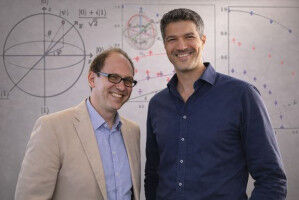
Stefan Wachter, Dmitry K. Polyushkin und Thomas Müller
Microprocessors based on atomically thin materials hold the promise of the evolution of traditional processors as well as new applications in the field of flexible electronics. Now, a TU Wien research team led by Thomas Müller has made a breakthrough in this field as part of an ongoing research project. Overview of the entire chip. AC = Accumulator, internal buffer; PC = Program Counter, points at the next instruction to be executed; IR = Instruction Register, used to buffer dataand instruction-bits received from the external memory; CU = Control Unit, orchestrates the other units according to the instruction to be executed; OR = Output Register, memory used to buffer output-data; ALU = Arithmetic Logic Unit, does the actual calculations. Two-dimensional materials, or 2D materials for short, are extremely versatile, although - or often more precisely because - they are made up of just one or a few layers of atoms. Graphene is the best-known 2D material. Molybdenum disulphide (a layer consisting of molybdenum and sulphur atoms that is three-atoms thick) also falls in this category, although, unlike graphene, it has semiconductor properties.
UM DIESEN ARTIKEL ZU LESEN, ERSTELLEN SIE IHR KONTO
Und verlängern Sie Ihre Lektüre, kostenlos und unverbindlich.