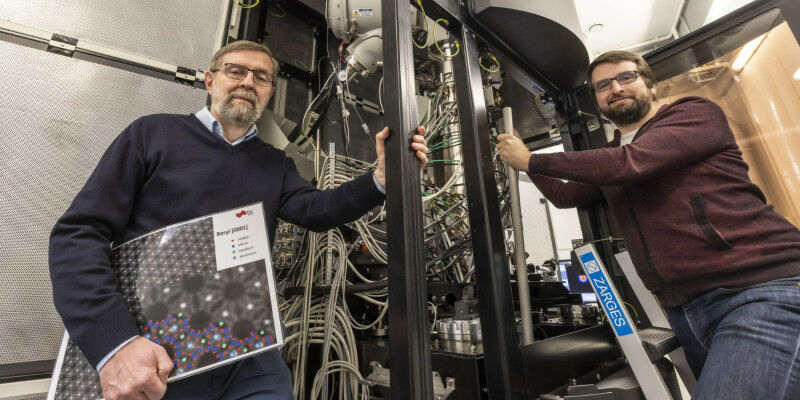
Ferdinand Hofer (left) and Daniel Knez next to the Austrian Scanning Transmission Electron Microscope (ASTEM) at the Institute of Electron Microscopy and Nanoanalytics at TU Graz. Image source: Lunghammer - TU Graz.
Ferdinand Hofer ( left ) and Daniel Knez next to the Austrian Scanning Transmission Electron Microscope (ASTEM) at the Institute of Electron Microscopy and Nanoanalytics at TU Graz. Image source: Lunghammer - TU Graz. Using only a single electron microscope image, researchers at TU Graz can determine the type and exact position of so-called guest atoms in high-tech materials. They also come closer to solving the mystery of the blue colour of aquamarine. In addition to their main components, the properties of crystalline and nanoporous materials often depend crucially on guest atoms or ions that are embedded in the tiny pores of their lattice structure. This applies to high-tech materials used in sensor or separation technology as well as to natural materials. The bluish gemstone aquamarine, for example, would be colourless without such guest components.
UM DIESEN ARTIKEL ZU LESEN, ERSTELLEN SIE IHR KONTO
Und verlängern Sie Ihre Lektüre, kostenlos und unverbindlich.