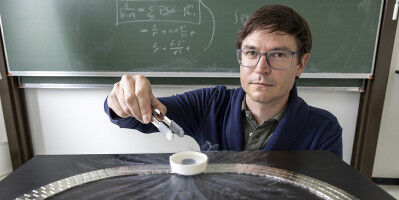
Scientist Marissa Giustina, first author of the publication, installs superconducting detectors in the "Alice" cryostat. (Photo: L. Lammerhuber)
A team of international researchers performed an experiment in the Vienna Hofburg to observe quantum entanglement with unprecedented certainty. Researchers in Anton Zeilinger's group from the Quantum Optics, Quantum Nanophysics and Quantum Information division of the University of Vienna physics department and from the Institute for Quantum Optics and Quantum Information (IQOQI) Vienna of the Austrian Academy of Sciences (OeAW), in an international collaboration, have demonstrated a definitive confirmation of quantum entanglement. The researchers report on their work in a publication on the Open Access platform arXiv.org, and have also submitted their work to the scientific journal "Physical Review Letters". Entangled pair - The phenomenon of entanglement, as predicted by quantum theory, represents a connection between particles that is difficult to grasp with our everyday intuition. When a measurement is performed on one partner of an entangled pair, there is an instant change of the quantum state of the other partner, regardless of the distance between the particles. In addition, quantum theory considers the measured properties of the particles to be completely undefined right up to the point of the measurement itself. Given this description from quantum theory, Albert Einstein referred to the phenomenon of quantum entanglement as "spooky action at a distance." - Results improved - As early as 1964, physicist John Bell formulated an experimental approach for testing this "spooky action at a distance." Yet, every experiment requires assumptions that provide in principle loopholes for a non-quantum explanation.
UM DIESEN ARTIKEL ZU LESEN, ERSTELLEN SIE IHR KONTO
Und verlängern Sie Ihre Lektüre, kostenlos und unverbindlich.