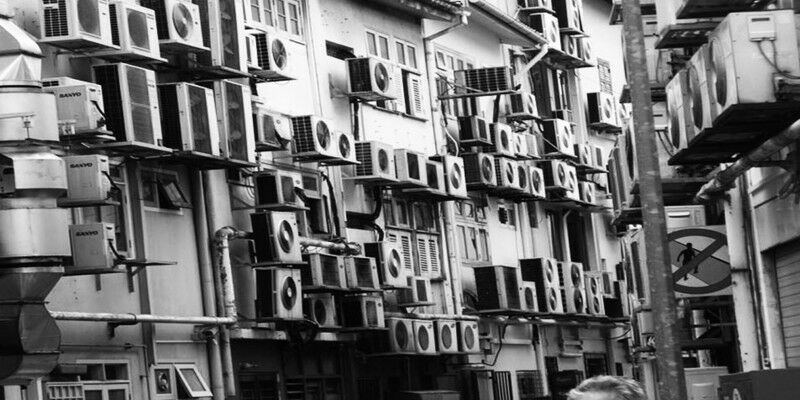
Split-system air conditioning units in Hong Kong (2010). Air conditioning has become an ingrained standard, especially in tropical and subtropical areas.
A breath of fresh air: The Institute of Architecture Technology of TU Graz is working on architectural solutions for better room climate in subtropical and tropical regions. Hong Kong, the metropolis with its seven million inhabitants, is among the most densely populated regions in the world. Current forecasts predict that densification will further increase in Asian metropolises in future - which in turn will mean increases in an already soaring power consumption, mainly because of the use of air conditioning units. These often appear to be the only response to heat, humidity, noise and air pollution in this subtropical region. Ferdinand Oswald from the Institute of Architecture Technology of TU Graz explains: "It is expected that air conditioning will drive up energy consumption by an additional 6.8 gigawatt hours each year in Hong Kong alone." This enormous energy demand has not only financial consequences, it also affects the climate-related energy footprint. Power consumption of 10,000 kWh per person and year, for example, corresponds to 2.7 tons CO2 emissions. Split-system air conditioning units on the façade of a residential high-rise in Kowloon, Hong Kong (2011).
UM DIESEN ARTIKEL ZU LESEN, ERSTELLEN SIE IHR KONTO
Und verlängern Sie Ihre Lektüre, kostenlos und unverbindlich.