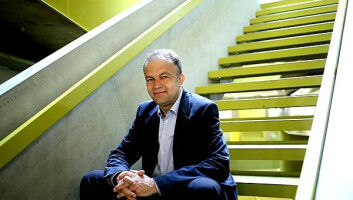
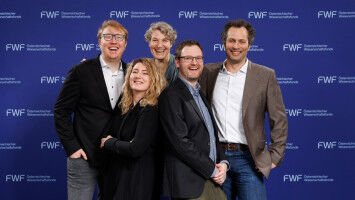
Sonja Langthaler, Christian Baumgartner and Theresa Rienmüller, all from the Institute of Health Care Engineering at TU Graz, were the first to pursue the idea of a simulation model for cancer cells. (from left to right)
Sonja Langthaler, Christian Baumgartner and Theresa Rienmüller, all from the Institute of Health Care Engineering at TU Graz, were the first to pursue the idea of a simulation model for cancer cells. ( from left to right ) © Lunghammer - TU Graz By Susanne Eigner - The computer model, developed under the lead management of researchers at TU Graz, simulates the cyclical changes in the membrane potential of a cancer cell using the example of human lung adenocarcinoma and opens up completely new avenues in cancer research. Computer models have been standard tools in basic biomedical research for many years. However, around 70 years after the first publication of an ion current model of a nerve cell by Hodgkin & Huxley in 1952, researchers at Graz University of Technology (TU Graz), in collaboration with the Medical University of Graz and the Memorial Sloan Kettering Cancer Center in New York, have finally succeeded in developing the world's first cancer cell model, thus launching "an essential tool for modern cancer research and drug development," reports a delighted Christian Baumgartner. The head of the Institute of Health Care Engineering with European Testing Center of Medical Devices at TU Graz is senior author of the publication in which the digital model is presented in the journal PLoS Computational Biology . Excitable and non-excitable cells. Digital cell models have so far focused on excitable cells such as nerve or cardiac muscle cells, allowing the simulation of electrophysiological processes not only at the cellular level, but also at the tissue and organ level.
UM DIESEN ARTIKEL ZU LESEN, ERSTELLEN SIE IHR KONTO
Und verlängern Sie Ihre Lektüre, kostenlos und unverbindlich.
Ihre Vorteile
- Zugang zu allen Inhalten
- Erhalten Sie Newsmails für Neuigkeiten und Jobs
- Anzeigen veröffentlichen