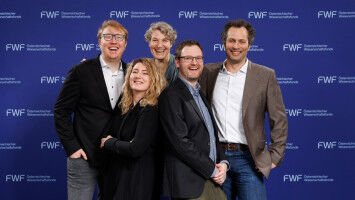
TU Graz computer scientists Robert Legenstein and Wolfgang Maass are working with other researchers to take AI a big step further.
TU Graz computer scientists Robert Legenstein and Wolfgang Maass are working with other researchers to take AI a big step further. Lunghammer - TU Graz By Christoph Pelzl New findings by researchers led by TU Graz computer scientists Wolfgang Maass and Robert Legenstein on neural information processing in the brain could enable more efficient AI methods. Additional can be found at the end of the message Specifically, the researchers have succeeded in mathematically modelling the emergence and interaction between so-called "assemblies". These are neuron groups in the brain that form the basis for higher cognitive abilities such as thinking, imagining, arguing, planning or speech processing. Better understanding of how the brain works. The Canadian neuroscientist Donald H. Hebb postulated as early as 1949 that neurons form such groups, in other words that they act together to encode individual words or symbols, as well as holistic "concepts". "However, the existence of assemblies has only become more consolidated in recent years, and our models are based on the latest results from brain research," explains Maass.
UM DIESEN ARTIKEL ZU LESEN, ERSTELLEN SIE IHR KONTO
Und verlängern Sie Ihre Lektüre, kostenlos und unverbindlich.
Ihre Vorteile
- Zugang zu allen Inhalten
- Erhalten Sie Newsmails für Neuigkeiten und Jobs
- Anzeigen veröffentlichen