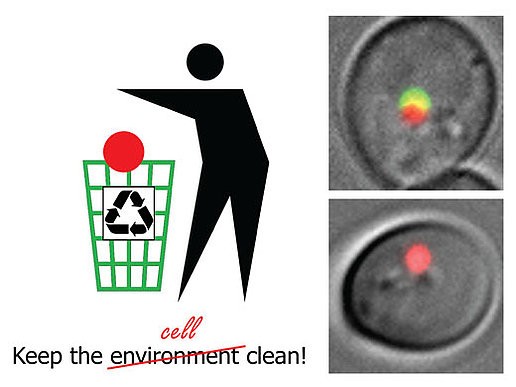
Cells must dispose of garbage, too. The responsible cellular process - autophagy - can be visualized as packing waste (red) in a bag (green) and monitored in live cells under the microscope (top right). The key coordinator of this cellular "garbage collection" is the protein Atg1. When the team of Claudine Kraft abolished Atg1’s ability to modify a component of the "waste bag", the cells were unable to package their waste (bottom right). This finding substantially furthers our understanding of this important cellular process, the malfunction of which can lead to Alzheimer’s disease and cancer. (Copyright: Daniel Papinski)
New findings from the team of Claudine Kraft at the Max F. Perutz Laboratories (MFPL) of the University of Vienna and the Medical University of Vienna give insights into how cells dispose of their waste. Malfunctions in this process have been linked to Alzheimer's disease and cancer. The study is published online in the renowned scientific journal Molecular Cell. Autophagy - or how cells tidy up - "Bang and the dirt is gone!" There are many commercials for products that claim to make the unpopular process of cleaning up easier. But it's not only our surroundings that need to be kept clean. Even our cells need to tidy up. The responsible cellular process is called autophagy, in which the coordinated action of a set of proteins removes damaged cell material or pathogens, such as bacteria, from a cell.
UM DIESEN ARTIKEL ZU LESEN, ERSTELLEN SIE IHR KONTO
Und verlängern Sie Ihre Lektüre, kostenlos und unverbindlich.