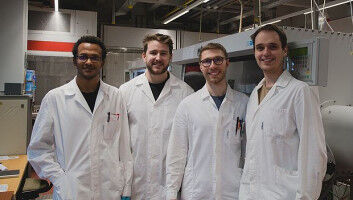
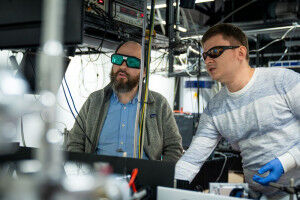
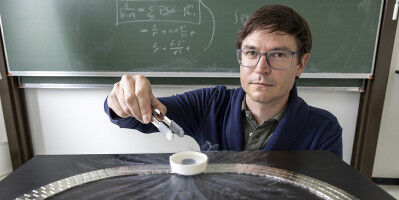
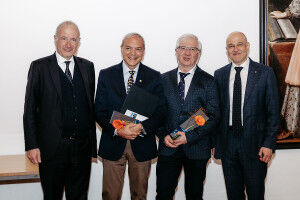
L. to.r.: Günther Rupprechter (front), Philipp Winkler (back), Patrick Zeller, Johannes Zeininger, Matteo Amati, Luca Gregoratti, Yuri Suchorski (top), Michael Stöger Pollach (bottom).
L. to.r. Günther Rupprechter (front), Philipp Winkler (back), Patrick Zeller, Johannes Zeininger, Matteo Amati, Luca Gregoratti, Yuri Suchorski ( top ), Michael Stöger Pollach ( bottom ) . Why do metal oxide surfaces behave differently? At TU Wien, a new research method was found to answer important questions. Metal surfaces play a role as catalysts for many important applications - from fuel cells to the purification of car exhaust gases. However, their behaviour is decisively affected by oxygen atoms incorporated into the surface. This phenomenon has been known for a long time, but until now it has not been possible to precisely investigate the role of oxygen in complex surfaces point by point in order to understand the chemical background at the atomic level. This has now been achieved at TU Wien in cooperation with a team from the Elettra Synchrotron in Trieste.
UM DIESEN ARTIKEL ZU LESEN, ERSTELLEN SIE IHR KONTO
Und verlängern Sie Ihre Lektüre, kostenlos und unverbindlich.