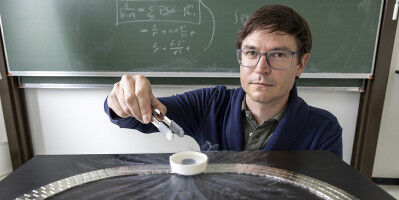
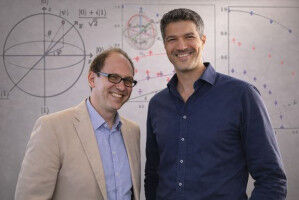
The Team Patrick Chalupa, Matthias Reitner, Alessandro Toschi (v.l.n.r.) Patrick Chalupa, Matthias Reitner, Alessandro Toschi (v.l.n.r.)
The Team Patrick Chalupa, Matthias Reitner, Alessandro Toschi (v.l.n.r. Patrick Chalupa, Matthias Reitner, Alessandro Toschi (v.l.n.r. For years, physicists at TU Wien have been studying strange phenomena - now they have found an explanation that could help to understand unconventional types of superconductivity. Materials can assume completely different properties - depending on temperature, pressure, electrical voltage or other physical quantities. In theoretical solid-state physics, state-of-the-art computer models are used to understand these properties in detail. Sometimes this works well, but sometimes strange effects occur that still seem puzzling - such as phenomena linked to high-temperature superconductivity. A few years ago, scientists at TU Wien were already able to clarify mathematically where the boundary lies between the area that follows the known rules and the area where unusual effects play an important role.
UM DIESEN ARTIKEL ZU LESEN, ERSTELLEN SIE IHR KONTO
Und verlängern Sie Ihre Lektüre, kostenlos und unverbindlich.