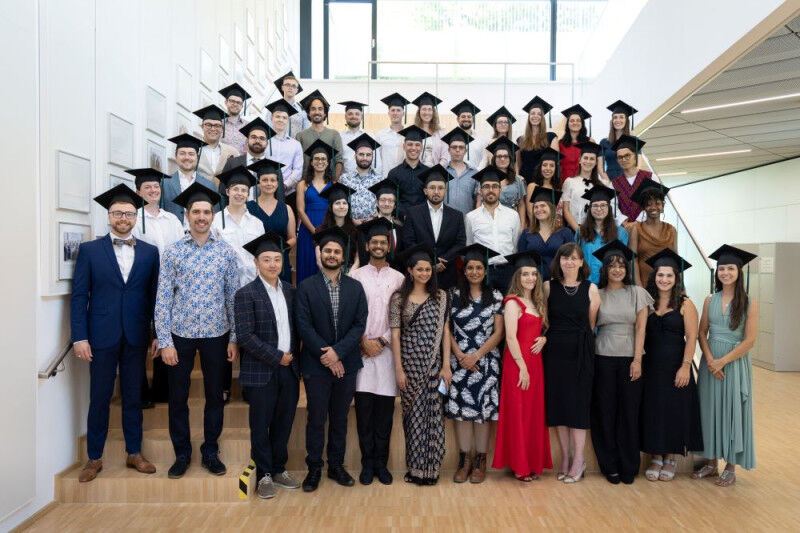
After around five years as a PhD candidate, the ceremony is a big step for the graduates. Eva Benková, Dean of the Graduate School at the Institute of Science and Technology Austria (ISTA), underlined its significance: "The graduation ceremony is more than a rite of passage. It is a moment of pause and appreciation. It allows us to acknowledge not only our students’ academic achievements but also the resilience, creativity, and drive that have shaped their time at ISTA. Their research journeys have enriched the community in countless ways, and we cannot wait to see the things they go on to achieve."
The graduates hailing from five continents, around 45 percent of them female, received their degrees on Thursday during a celebration in the Moonstone Seminar Center of the Institute. Benková and ISTA President Martin Hetzer congratulated all the graduates before handing the floor to Balázs Szendroi, Professor of Algebraic Geometry at the University of Vienna and Chair of the Committee for Developing Countries of the European Mathematical Society.
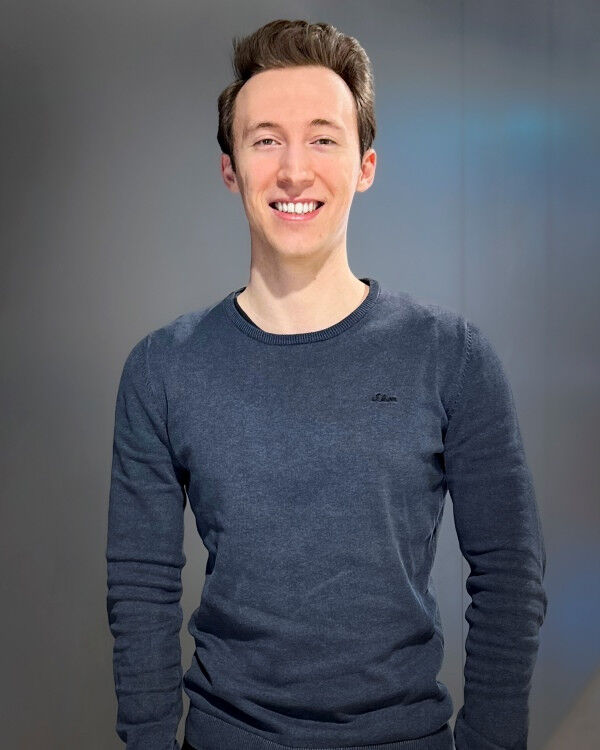
Background: Interdisciplinary and Fully Funded PhD Program at ISTA
Graduate School at the Institute of Science and Technology Austria (ISTA) offers an interdisciplinary, fully funded PhD program. It supports students in becoming world-class researchers in their fields while fostering exchange and collaboration across research groups and disciplines. The training consists of both research and teaching elements. PhD students benefit especially from the mentoring by world-class faculty from all large natural science disciplines. Irrespective of their earlier specialization, all students whose broad research interests align with those of research groups at ISTA are eligible to join the ISTA PhD program.
Unique is the rotational system of the Institute: First-year PhD students are researching in at least three research groups of their choice to experience other fields’ methods and academic questions. This way, interdisciplinary thinking and scientific exchange across disciplines are already fostered at a very early stage.While educating PhD students is a core mission of the Institute, since 2021, there is also the possibility to receive a Master’s degree on the way to a PhD. This year, three students at ISTA made use of that offer.
Outstanding PhDs
The ISTA Outstanding PhD Thesis Award recognizes outstanding achievements based on nominations by ISTA Professors. This year’s winners are Elias Frantar from the Alistarh Group , Georg Arnold from the Fink Group, Huihuang Chen from the Friml Group , Joscha Henheik from the Erdös Group , and Volker Karle from the Lemeshko Group.Growing field, shrinking models
Elias Frantar, born and raised in Vienna, Austria, wrote about "Compressing Large Neural Networks: Algorithms, Systems, and Scaling Laws." While Large Language Models (LLMs) have become an extremely powerful tool, e.g., in form products like ChatGPT, they generally require massive amounts of compute and energy to train and run. Frantar’s work aims to ’shrink’ and thus ’democratize’ those models without losing significant accuracy.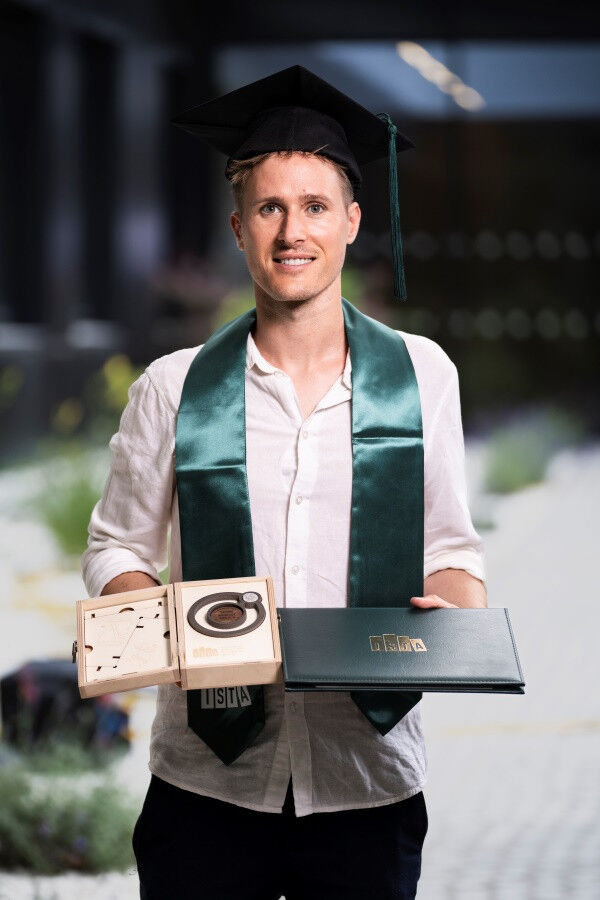
His supervisor, Dan Alistarh , underlines, "Elias Frantar’s thesis represents an extraordinary contribution to the field of machine learning efficiency, demonstrating a rare combination of scientific innovation and real-world impact. As evidence of impact, models compressed using his techniques have been downloaded more than 40 million times from open-source repositories. With over 3000 citations at the end of 4 years, substantial adoption in both academic and industrial settings, and significant influence on future research directions, his work stands out as truly excellent."
Frantar, who is working at OpenAI now, talks enthusiastically about his time at ISTA: "I first heard about ISTA a few years after its founding when I was still in high school and immediately loved the idea of establishing a world-class research institution near my home city, Vienna. During my PhD, I saw in real-time how ISTA became more well-known for excellent machine learning research. This was thanks to all the great work done by everyone at the Institute, and hopefully a bit due to mine, too. I am confident this will continue!"
A ’modem’ for quantum computers
Georg Arnold, born in Wolfsberg, Carinthia, Austria, wrote his thesis about "Microwave-Optic Interconnects for Superconducting Circuits." Quantum computing promises to tackle problems beyond the reach of even today’s most powerful supercomputers. However, scaling quantum systems is a major hurdle. Arnold describes his work done with the Fink Group as aiming to overcome that. "One can say, we were building a type of modem for quantum computers-an electro-optic quantum transducer. Just like classical modems connect devices via the internet, ours aims to link quantum computers via optical fibers , enabling large-scale networks and new applications."His supervisor, Johannes Fink , underlines, "Convincing Georg to join our group was probably one of the most important and defining moments for my back then still very young lab. All in all, what he did could easily count for two PhDs. Results led to Georg being invited to speak at the APS meeting, Harvard, Google, and others. He thinks big and in context and identifies opportunities, while at the same time paying great attention to detail and developing the theory behind it. He also was always available to help others in the team."
Arnold similarly underlines the role of successful teamwork and excellence: "Every research group at ISTA operates at a world-class level, and I’ve had the privilege of working alongside so many truly brilliant minds. It feels almost unfair to single out individuals, but I am grateful that our work in the Fink group-and the amazing support from ISTA’s technical facilities and administration-is being recognized in this way." Since leaving ISTA, he has been further developing electro-optic transducers at QphoX, aiming for large-scale application. "My focus will stay on making quantum and quantum-classical hybrid computing practically useful-pushing the boundaries of both application and understanding in quantum technologies."
An animal messenger in plants
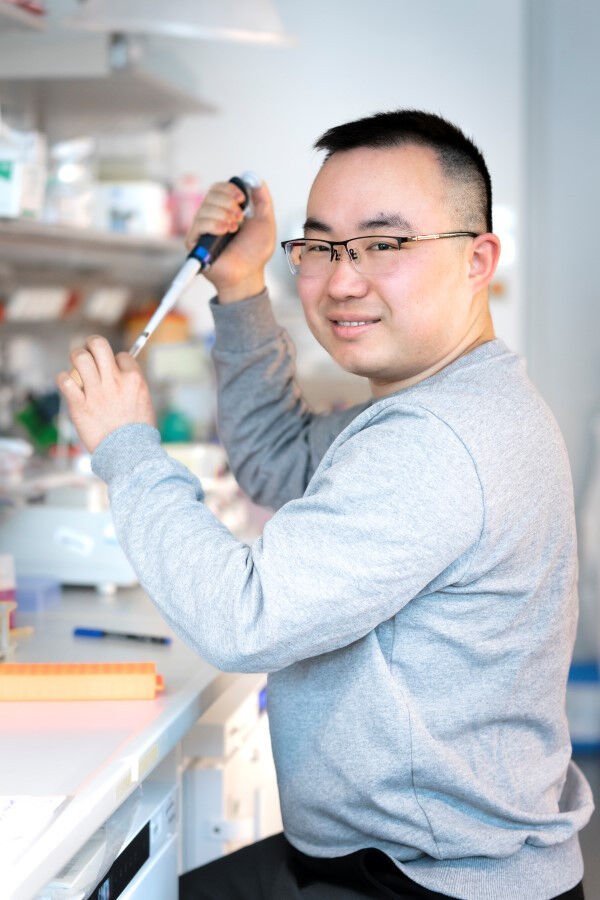
The third awardee, Huihang Chen from Dehua County in China, gave his thesis the title "The cAMP second messenger in auxin signalling." cAMP, a well-established universal signaling molecule in animals-- functioning somewhat like a traffic light-has now been demonstrated to be effective in plants as well.His supervisor, Jirí Friml , speaking for the committee, praises his achievements as follows: "Huihang Chen’s research redefines fundamental concepts in plant hormone biology by identifying cAMP as a second messenger in plants and revising one of the major signaling mechanisms in plants-that for the phytohormone auxin that stood for over 20 years. These findings are transformative of the whole plant signaling field and open entirely new research avenues. These profound insights have led to high-impact publications, including in one of the most prestigious plant-specific journals, Molecular Plant, as well as in PNAS and Nature."
Awardee Chen expresses his thankfulness to supervisors, the committee, and lab colleagues, pointing out that "this recognition is deeply shared." Happy to have resolved a longstanding debate, he is already looking towards the future, "Our forthcoming unpublished results will reveal how cAMP functions in plants, ultimately connecting its biosynthesis to its physiological roles and molecular mechanisms." Hailing from a region renowned for its ceramics, his family has combined his research into plants and his origin into a special graduation gift: a ceramic flower arrangement. The ISTA Outstanding PhD Award will now be added to the items celebrating Chen’s scientific success.
Bridging math and (quantum) physics
Joscha Henheik from Eldingen in Lower Saxony, Germany, did his PhD in the research group of mathematician László Erdös at ISTA. Henheik is focused on solving mathematical problems originating from physics; specifically, questions arising from complex quantum systems. "Quantum mechanics is ubiquitous in our modern life. My research contributes to establishing its solid mathematical foundation," Henheik says. He thus wrote his thesis about "Modeling complex quantum systems: Random matrices, BCS theory, and quantum lattice systems."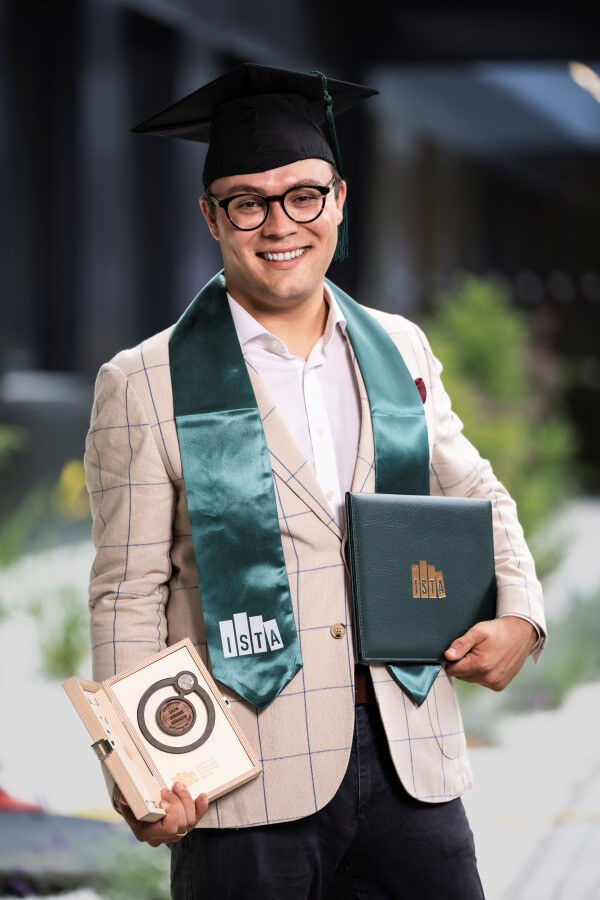
In his review, Professor Benjamin Schlein of the University of Zurich underlined that "the thesis of Mr. Henheik is an excellent piece of work in mathematical physics. It contains very interesting and deep mathematical results in random matrix theory, in BCS theory, and in the theory of quantum lattice systems. The broadness of the subjects that are treated in the thesis and the variety of the mathematical tools that are used are extremely impressive. It shows a remarkable scientific maturity of Mr. Henheik."
"ISTA was the perfect place for my PhD," says Henheik. "I feel very blessed to have worked here and will keep this productive time in fond memory." He will now continue with postdoctoral positions in Geneva and Copenhagen. "There, I plan to expand my scientific horizon by working on random graphs and other areas of mathematical quantum mechanics, which I have not yet investigated. Personally, a lot of my time is now dedicated to my young family."
New insights in established areas
A bottle of Champagne that Volker Karle bought half a decade ago, around the time he started his PhD, is now ready to be cracked open, as he also receives an Outstanding PhD Award from ISTA. Karle’s interest is the field of quantum mechanics, which already underpins technologies like solar cells, catalytic chemistry, and quantum-dot OLED screens in smartphones. Concretely, his thesis focused on understanding quantum rotation, which involves mathematical aspects from a field called "topology."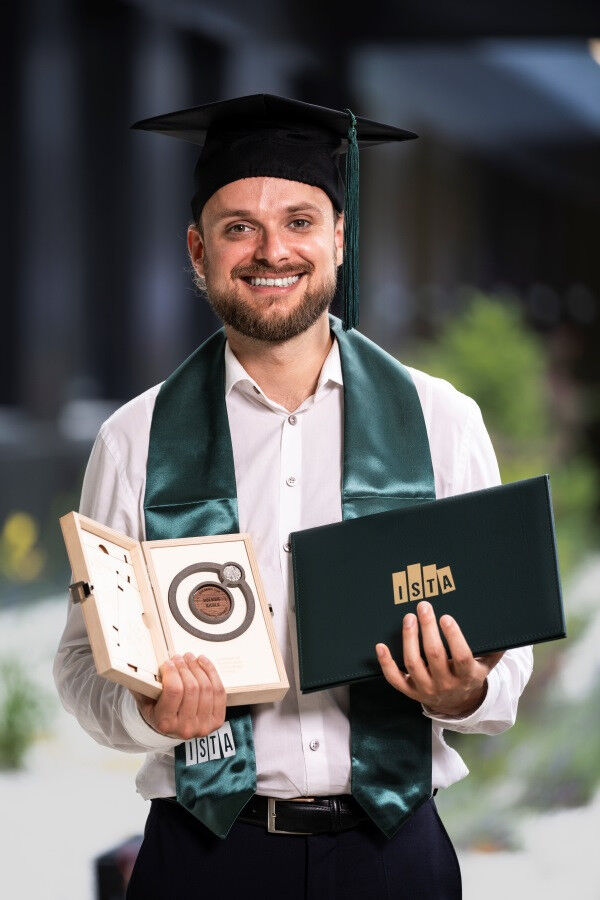
Karle was born in Künzelsau, Baden-Württemberg, Germany, a city known for another physicist, Astronaut Alexander Gerst. For now, he plans to not only stay on Earth, but also in academia: "I aim to expand my view to more broadly driven quantum systems that could be used as novel materials or devices."