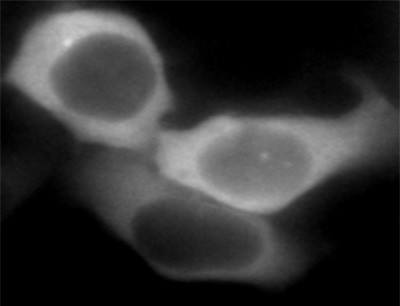
Fluorescence image shows the binary interaction of PKA subunits in human cells.
(Picture: Adapted from Stefan et al. Nat. Commun. 2011)
Extracellular cues are recognized by G-protein-coupled receptors which transmit the signal via trimeric G proteins to their cellular effectors. Dr. Eduard Stefan from the Institute of Biochemistry showed in cooperation with international research teams a novel and conserved mechanism how cells adapt to environmental changes. Photo: Fluorescence image shows the binary interaction of PKA subunits in human cells.
(Picture: Adapted from Stefan et al. Nat. Commun. The pharmacological most important group of sensor molecules in the plasma membrane of living cells is the G-protein-coupled receptor family.
TO READ THIS ARTICLE, CREATE YOUR ACCOUNT
And extend your reading, free of charge and with no commitment.