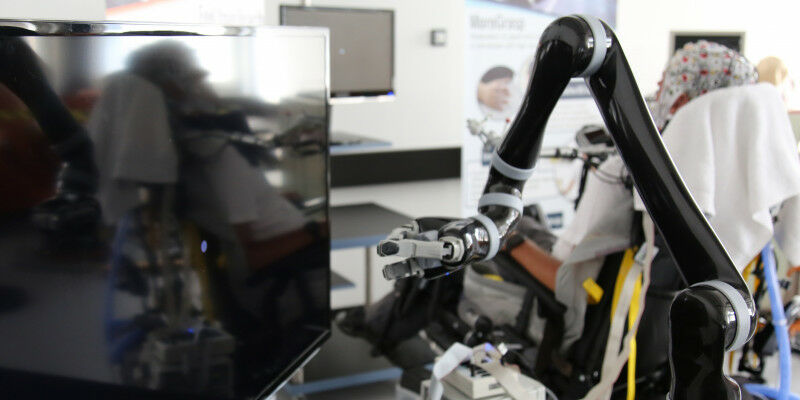
 TU Graz researchers have succeeded for the first time in controlling a robotic arm purely by thought in real time in the usual non-invasive way using an EEG cap. Here in the
TU Graz researchers have succeeded for the first time in controlling a robotic arm purely by thought in real time in the usual non-invasive way using an EEG cap. Here in the picture: the experimental setting. In front, the robotic arm controlled by the test person (behind). Baustädter - TU Graz By Christoph Pelzl - For the first time ever, the intention of a continuous movement was able to be read out from non-invasive brain signals at TU Graz. This success enables more natural and non-invasive control of neuroprostheses to be carried out in real time. Intended to give paraplegic people back some freedom of movement and thus a better quality of life, so-called brain-computer interfaces (BCIs) measure the person's brain activity and convert the electrical currents into control signals for neuroprostheses. "Controlling by thoughts," as Gernot Müller-Putz puts it in simplified terms.
TO READ THIS ARTICLE, CREATE YOUR ACCOUNT
And extend your reading, free of charge and with no commitment.
Your Benefits
- Access to all content
- Receive newsmails for news and jobs
- Post ads