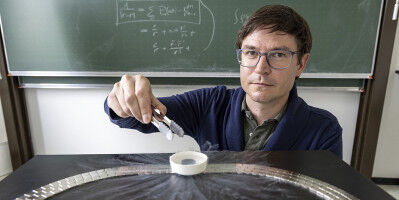
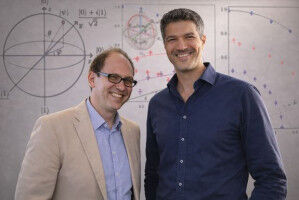
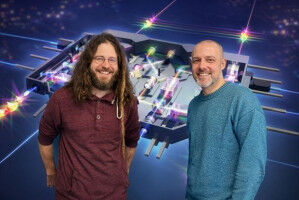
In 1940, Hendrik Kramers (left) predicted theoretically that in a double-well system (center bottom) transitions between the stable states happen most frequently at intermediate friction (upper right). The background shows a detail of the laser system used to confirm Kramers’ prediction experimentally (Copyrights: Jan Gieseler; Image of H. Kramers courtesy of AIP Emilio Segrè Visual Archives, Goudsmit Collection).
Transitions occurring in nanoscale systems, such as a chemical reaction or the folding of a protein, are strongly affected by friction and thermal noise. Almost 80 years ago, the Dutch physicist Hendrik Kramers predicted that such transitions occur most frequently at intermediate friction, an effect known as Kramers turnover. Now, reporting , a team of scientists from the ETH Zurich, ICFO in Barcelona and the University of Vienna have measured this effect for a laser-trapped particle, directly confirming Kramers' prediction in an experiment for the first time. In 1827, the English botanist Robert Brown made an observation of seemingly little importance that would turn out to play a central role in the development of the atomic theory of matter. Looking through the objective of a microscope, he noticed that pollen grains floating in water were constantly jiggling around as if driven by an invisible force, a phenomenon now known as Brownian motion. It was later understood that the irregular motion of the pollen particle is caused by the incessant buffeting of the water molecules surrounding the pollen particle. Albert Einstein's theoretical analysis of this phenomenon provided crucial evidence for the existence of atoms.
TO READ THIS ARTICLE, CREATE YOUR ACCOUNT
And extend your reading, free of charge and with no commitment.