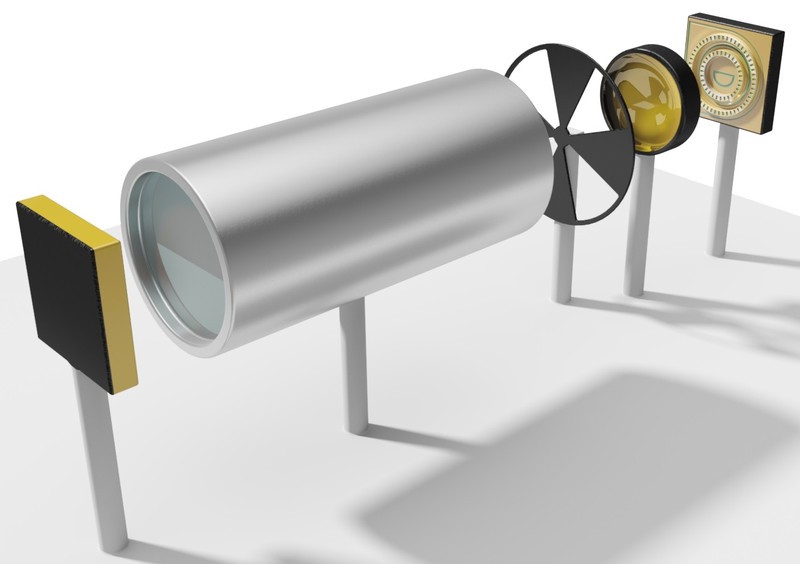
Versuchsaufbau: Der Laser (rechts) sendet sein Licht durch einen Testbehälter, danach wird es von einem Spiegel (links) reflektiert und gelangt zurück.
A laser and detector in one: a microscopic sensor has been developed at TU Wien, which can be used to identify different gases simultaneously. The laser (on the right) sends its light through a gas container, then the beam is reflected by a mirror (left). As humans, we sniff out different scents and aromas using chemical receptors in our noses. In technological gas detection, however, there are a whole host of other methods available. One such method is to use infrared lasers, passing a laser beam through the gas to an adjacent separate detector, which measures the degree of light attenuation it causes. TU Wien's tiny new sensor now brings together both sides within a single component, making it possible to use the same microscopic structure for both the emission and detection of infrared radiation. Circular quantum cascade lasers - 'The lasers that we produce are a far cry from ordinary laser pointers ,' explains Rolf Szedlak from the Institute of Solid State Electronics at TU Wien.
TO READ THIS ARTICLE, CREATE YOUR ACCOUNT
And extend your reading, free of charge and with no commitment.