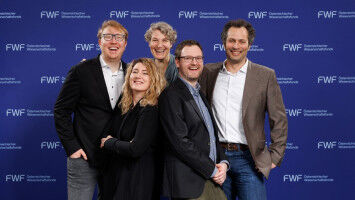
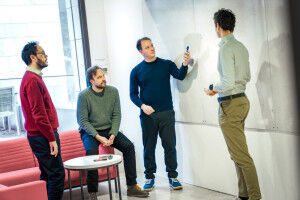
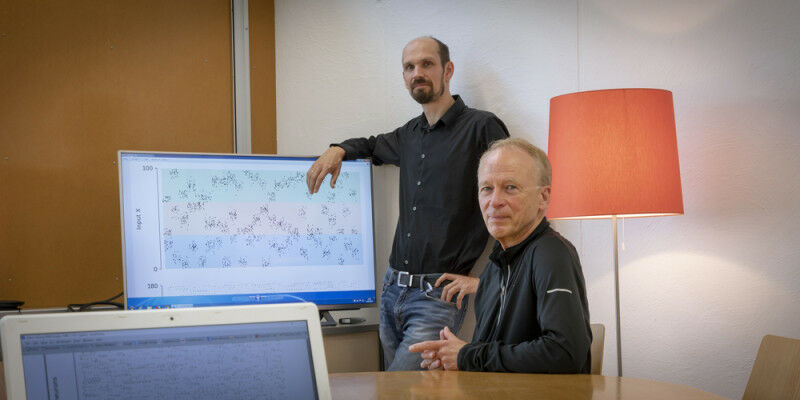
 Robert Legenstein (left) and Wolfgang Maass (right) are working on the decoding of the human brain at the Institute of Theoretical Computer Science.
The human brain has computing elements similar to the biggest supercomputers, but needs only a fraction of their energy. And it is constantly learning. Brain-inspired computing is for this reason an important topic of the future. 'Colleagues in neuroscience think that we basically know less today about how the human brain works than we did ten years ago,' says Wolfgang Maass. In his work, the computer scientist has specialised in finding out how the computer centre in our heads processes information and how this way of working can be applied to computers. The human brain is a complex, extremely efficient and powerful organ for processing information. Since at the same time it manages with about a million times less energy than a supercomputer - despite more or less the same number of computing elements - it has been the object of intense research in industry in the last few years.
TO READ THIS ARTICLE, CREATE YOUR ACCOUNT
And extend your reading, free of charge and with no commitment.
Your Benefits
- Access to all content
- Receive newsmails for news and jobs
- Post ads