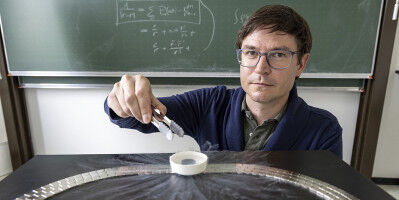
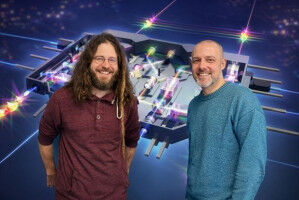
A tightly focused laser field traps a nanoparticle between two highly reflecting mirrors, i.e. an optical cavity. Preferential scattering along this optical resonator allows to induce cooling of the nanoparticle motion in all three directions.
When a particle is completely isolated from its environment, the laws of quantum physics start to play a crucial role. One important requirement to see quantum effects is to remove all thermal energy from the particle motion, i.e. to cool it as close as possible to absolute zero temperature. Researchers at the University of Vienna, the Austrian Academy of Sciences and the Massachusetts Institute of Technology (MIT) are now one step closer to reaching this goal by demonstrating a new method for cooling levitated nanoparticles. They now publish their results in the renowned journal Physical Review Letters. Tightly focused laser beams can act as optical "tweezers" to trap and manipulate tiny objects, from glass particles to living cells. The development of this method has earned Arthur Ashkin the last year's Nobel prize in physics. While most experiments thus far have been carried out in air or liquid, there is an increasing interest for using optical tweezers to trap objects in ultra-high vacuum: such isolated particles not only exhibit unprecedented sensing performance, but can also be used to study fundamental processes of nanoscopic heat engines, or quantum phenomena involving large masses.
TO READ THIS ARTICLE, CREATE YOUR ACCOUNT
And extend your reading, free of charge and with no commitment.
Your Benefits
- Access to all content
- Receive newsmails for news and jobs
- Post ads