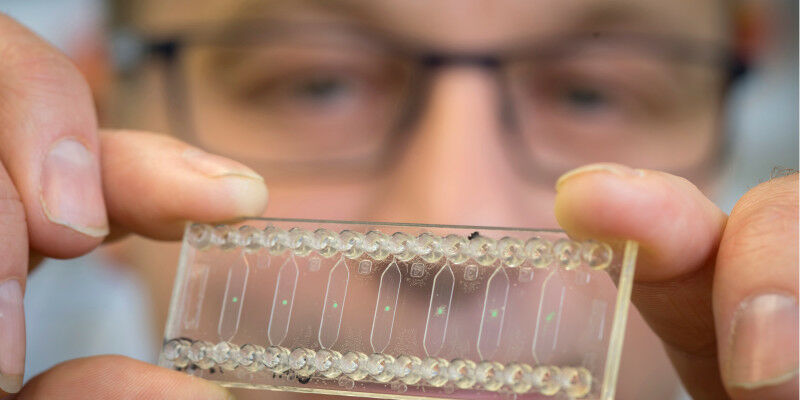
Microfluidic chip for cell cultures with integrated sensors (green spots for oxygen, pH and glucose. The sensors allow for a continuous control of cell viability and metabolism.
Microbioreactors with integrated sensors enable improved and well-controlled reaction conditions to be produced and are increasingly used in biocatalysis, process optimisation, diagnosis and cell culturing. Microbioreactors are miniaturised bioreactors with structures on the micrometre scale. They are a special field of microfluidics or lab-on-chip technology and consist of chambers and channels in sizes from 10 um to 3 mm and depths from 10 to 800 um. They are made of glass, silicone or polymeric materials. Compared with conventional bioreactors, and thanks to their small volume and shorter transport distances, microbioreactors are characterised by faster heat transport, improved reaction control, reduced safety risk, fewer material and energy requirements, and greater product yield. They allow the production of small amounts in batch, but also continuous production. Microbioreactors allow us to perform experiments in controllable test conditions and have the potential for use in all chemical and biochemical applications, e.g. industrial processing, process optimisation, preparation of personalized medicine and in laboratories for research and development.
TO READ THIS ARTICLE, CREATE YOUR ACCOUNT
And extend your reading, free of charge and with no commitment.