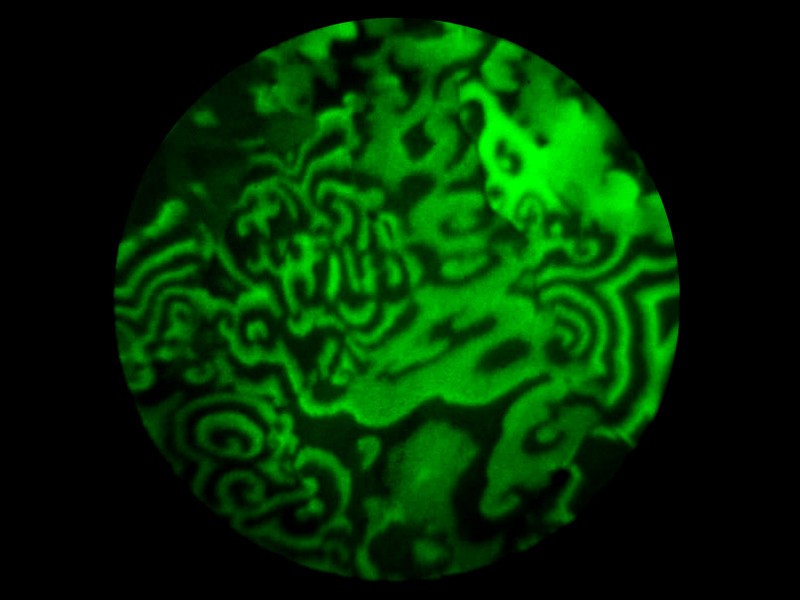
Spiralförmige Wellen bilden sich auf der Rhodium-Folie. Sie liefern wichtige Information über die chemischen Eigenschaften der Oberfläche.
Spectacular electron microscope images at TU Wien lead to important findings: Chemical reactions can produce spiral-like multi-frequency waves and thus provide local information about catalysts. They appear almost hypnotic, like a lava lamp. The waves made visible at TU Wien using a photoemission electron microscope cover the surface of rhodium foil with bizarre patterns which dance around on the surface. Waves are known in many very different forms; as water waves, light waves or sound waves. But here we are dealing with something quite different - chemical waves. A chemical reaction takes place on the surface of a crystal, but this does not progress in one direction only: instead, it returns periodically to its original state. Depending on the phase of this cyclically progressing reaction, the surface of the rhodium crystal appears as bright or dark under the photoemission electron microscope.
TO READ THIS ARTICLE, CREATE YOUR ACCOUNT
And extend your reading, free of charge and with no commitment.