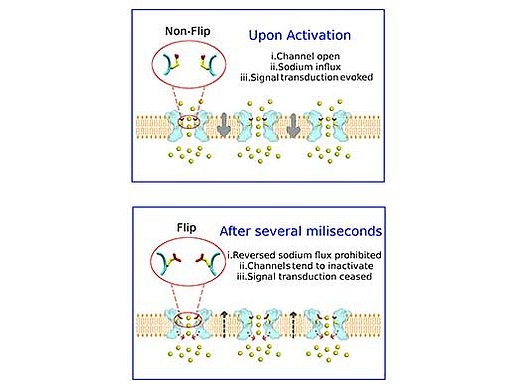
Schematic representation of the sodium ion channel (light blue): Top: influx of sodium ions (shown in yellow) and orientation of the E53 amino acid in "non-flipped" conformation. Bottom: conformational change of E53 (flip) during ion efflux, arrows indicate the barrier for sodium efflux
Ion channels are involved in many physiological and pathophysiological processes throughout the human body. A young team of researchers led by pharmacologist Anna Stary-Weinzinger from the Department of Pharmacology and Toxicology, University of Vienna investigated how ion flux through a voltage gated sodium ion channel works in detail. Since this process is incredibly fast (up to 100 million ions per seconds), computer simulations were performed to visualize sodium flux "in slow motion". The time consuming calculations were performed using the high performance computer cluster (VSC), which is currently the fastest computer in Austria. Recently, the results were published in PLOS Computational Biology. Electrical signals, generated by voltage gated ion channels are essential for survival. Without these proteins, fundamental body functions such as heart beat, signal transduction in our brain, or muscle contraction would not be possible. A remarkable feature of these extraordinary proteins is that they enable extremely rapid and selective ion flux. X-ray structures provided tremendous insights into the structure of these proteins. Guided by this structural information, investigating the details of ion selectivity and conductance becomes feasible. Crystal structures revealed a short, water filled "ion filter" structure at the extracellular side of the protein, surrounded by four negatively charged glutamic acid side chains, which enables selective sodium flux. However, from these "static" structures it is not easy to deduce how the dynamic process of ion flux works in detail. Thus, computer simulations are a great means to provide mechanistic insights into this process. Computer simulations visualize ion movements
UM DIESEN ARTIKEL ZU LESEN, ERSTELLEN SIE IHR KONTO
Und verlängern Sie Ihre Lektüre, kostenlos und unverbindlich.