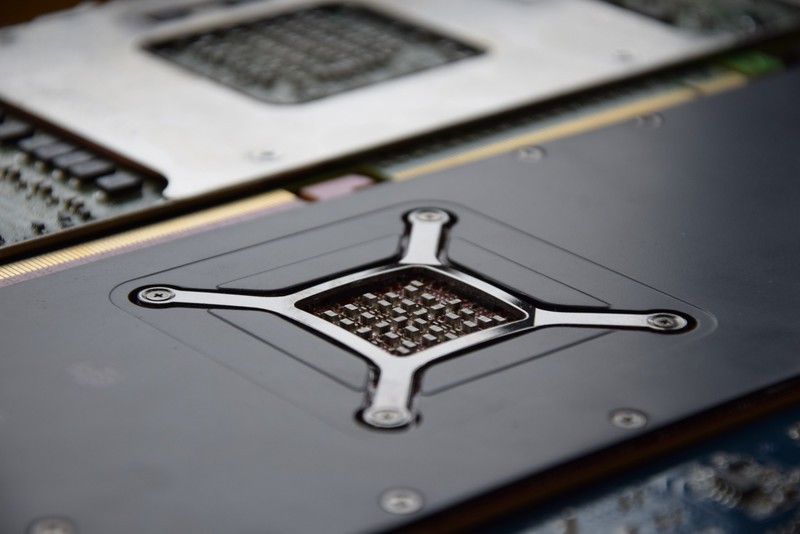
Grafikkarten helfen nicht nur bei Grafikanwendungen - an der TU Wien untersucht man, wie man sie für hoch anspruchsvolle wissenschaftliche Anwendungen nutzen kann.
TU Wien today announced that it has been named a GPU Research Center by NVIDIA, the world leader in visual computing. GPU Research Centers are institutions that embrace and utilize GPU technologies across multiple research fields, and are at the forefront of some of the world's most innovative scientific research. GPU computing leverages the parallel processing capabilities of GPU accelerators and enabling software to deliver dramatic increases in performance for scientific, artificial intelligence, deep learning, graphics, engineering, and other demanding applications. TU Wien was recognized for its advanced research in parallel linear algebra, fast iterative solvers and advanced preconditioners using GPUs. Significant contributions in the field of GPU computing have been made via the free open source software library ViennaCL headed by Karl Rupp and actively developed at the Institute for Microelectronics, TU Wien. Together with his colleagues Josef Weinbub and Florian Rudolf and the PETSc team at the Argonne National Laboratory, USA, GPU-accelerated routines for supercomputers will be developed and optimized for optimal performance in this GPU Research Center. This will allow practitioners all over the world to leverage the computational power of current and future supercomputers for research in such areas as fluid dynamics, structural mechanics, finance, and nanoelectronics.
TO READ THIS ARTICLE, CREATE YOUR ACCOUNT
And extend your reading, free of charge and with no commitment.