






news
Graz University of Technology
Results 1 - 20 of 303.
Physics - Materials Science - 09.03.2026
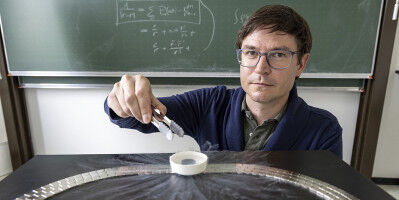
In a current strategy paper, an international team with the participation of TU Graz calls for the search for room-temperature superconductors to be pursued in a coordinated manner and with combined forces - and presents a programmatic approach for its success. The search for materials that can conduct electricity at room temperature without losing energy is one of the greatest and most consequential challenges of modern physics: loss-free power transmission, more efficient motors and generators, more powerful quantum computers, cheaper MRI devices.
Environment - Earth Sciences - 10.02.2026
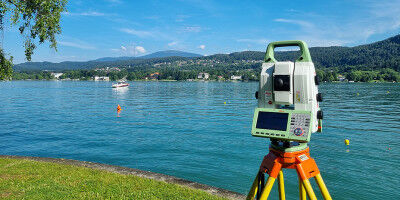
The new holistic monitoring system developed under the leadership of TU Graz measures boat waves with millimetre precision using satellite navigation data and sensors on buoys and for the first time allows investigations into the extent to which boat traffic, weather and other factors influence the ecosystem of lakes.
Transport - 05.02.2026

Insulated joint systems are crucial for safe railway operation, but are susceptible to faults. The newly developed insulated joint is intended to extend service life and reduce maintenance and repair costs. Insulated joints are little known, but many railway lines could not be used without them. They divide the rail network into electrically separated sections and register when a train enters and leaves a section.
Chemistry - Life Sciences - 20.01.2026
Researchers at TU Graz and the University of Graz can use the technology to construct artificial biocatalysts. These new enzymes are significantly faster, more stable and more versatile than previous artificial biocatalysts. Enzymes with specific functions are becoming increasingly important in industry, medicine and environmental protection.
Innovation - Environment - 15.01.2026

Materials Science - Physics - 02.12.2025
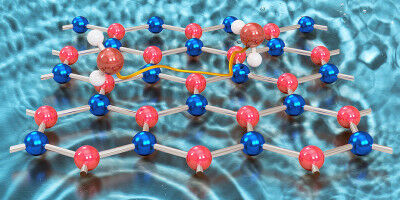
Instead of jumping, water molecules walk: Graz University of Technology and the University of Surrey show how water moves in surprisingly different ways on ultra-thin materials. In a study published in Nature Communications , researchers from Graz University of Technology (TU Graz) and the University of Surrey tested two ultra-thin, sheet-like materials with a honeycomb structure - graphene and hexagonal boron nitride (h-BN).
Materials Science - 20.11.2025
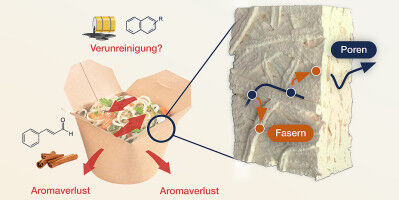
A new AI model developed by TU Graz combines data from laboratory tests with the laws of physics to calculate how well different types of paper protect food from flavour loss and contaminants.
Environment - 13.11.2025

TU Graz, TU Wien and the Environment Agency Austria have developed a method to determine microplastics in the inand outflow of sewage plants, and demonstrated their high elimination performance. The danger of microplastics for the environment and health has become increasingly recognised in recent years.
Agronomy & Food Science - 01.10.2025
Proven: Cereal Plants Absorb Nanoplastics
Using an advanced method, researchers at TU Graz and the Centre for Electron Microscopy have detected plastic in the roots of wheat plants. Whether the particles reach the ears of grain will be shown by further tests. Microplastics and nanoplastics in soils are a growing environmental problem. The extent to which agricultural crops absorb these particles and whether they end up in food has so far been difficult to prove.
Health - Life Sciences - 09.09.2025

In addition to cholesterol, the amino acid homocysteine also plays a role in aortic stiffening. Researchers from Graz University of Technology, the University of Graz and the Medical University of Graz were able to prove this in a new study. Cardiovascular diseases remain the most common cause of death worldwide.
Computer Science - Life Sciences - 07.08.2025

In the ERC project HelixMold, a team from TU Graz developed a method for the computer-based design of artificial proteins, with a focus on custom biocatalysts for pharmaceutical applications or the degradation of biopolymers. "Imagine a future in which you can design enzymes - natures catalysts - for your specific application at the push of button", says Gustav Oberdorfer who headed the ERC Starting Grant project 'HelixMold' at the Institute of Biochemistry of the Graz University of Technology (TU Graz).
Physics - Chemistry - 17.06.2025

A new method combines helium droplets with ultrashort laser pulses to initiate chemical processes in a controlled manner. This provides insights into the transfer of energy and charge during the formation of chemical bonds. For the first time, a research team led by Markus Koch from the Institute of Experimental Physics at Graz University of Technology (TU Graz) has tracked in real time how individual atoms combine to form a cluster and which processes are involved.
Physics - Chemistry - 17.06.2025

A new method combines helium droplets with ultrashort laser pulses to initiate chemical processes in a controlled manner. This provides insights into the transfer of energy and charge during the formation of chemical bonds. For the first time, a research team led by Markus Koch from the Institute of Experimental Physics at Graz University of Technology (TU Graz) has tracked in real time how individual atoms combine to form a cluster and which processes are involved.
Innovation - 30.04.2025

A research team at TU Graz has developed a system for structural monitoring that can be integrated directly into structural management and used sustainably for preventive maintenance planning. The safety and durability of transport and building infrastructure are in the interests of both operators and users.
Physics - Health - 14.04.2025

Together with the company BRAVE Analytics, researchers at TU Graz have developed a method for detecting nanoplastics in liquids and determining their composition. Microplastics and the much smaller nanoplastics enter the human body in various ways, for example through food or the air we breathe. A large proportion is excreted, but a certain amount remains in organs, blood and other body fluids.
Physics - Chemistry - 20.03.2025

Using machine learning workflows developed in-house, the researchers were able to establish that heat conduction is much more intricate than previously thought. Findings offer potential for developing specific materials. Complex materials such as organic semiconductors or the microporous metal-organic frameworks known as MOFs are already being used for numerous applications such as OLED displays, solar cells, gas storage and water extraction.
Astronomy & Space - Earth Sciences - 06.03.2025

By utilising communication signals for positioning and calculating the earth's gravitational field, real-time observation of weather phenomena is now also possible. Useable data are one of the most valuable tools scientists can have. The more data sources they have, the better they can make statements about their research topic.
Materials Science - Environment - 27.02.2025

Until now, old clothes have mainly been incinerated. Using adapted processes from paper production, it is possible to recover the cellulose fibres from used clothing and use them to produce cardboard and other packaging materials.
Environment - Earth Sciences - 19.02.2025

International researchers with the participation of TU Graz present a global assessment of ice loss since the beginning of the millennium.
Astronomy & Space - Computer Science - 30.10.2024

More accurate orbit predictions for satellites and space debris as well as a better understanding of the water masses present on Earth: Researchers at TU Graz have achieved both using satellite laser ranging. What do the Earth's gravitational field and the trajectories of satellites and space debris have in common? The Earth's gravitational field influences the orbits of our companions in space, while the changes in the orbits in turn allow conclusions to be drawn about changes in the gravitational field and thus existing water masses.


