





news
Computer Science
Results 1 - 20 of 125.
Physics - Computer Science - 16.02.2026
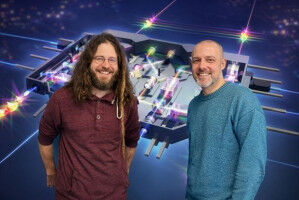
Together with a team in China a team at TU Wien extends the capabilities of quantum computers: Instead of combinations of 0s and 1s, the new technology uses four different states simultaneously.
Innovation - Computer Science - 09.12.2025

Researchers at TU Wien have discovered an unexpected connection between two very different areas of artificial intelligence: Large Language Models (LLMs) can help solve logical problems-without actually "understanding" them. Anyone who has spent hours struggling with a Sudoku puzzle knows the feeling: you're stuck until suddenly a small hint sets the entire solution in motion.
Computer Science - Life Sciences - 07.08.2025

In the ERC project HelixMold, a team from TU Graz developed a method for the computer-based design of artificial proteins, with a focus on custom biocatalysts for pharmaceutical applications or the degradation of biopolymers. "Imagine a future in which you can design enzymes - natures catalysts - for your specific application at the push of button", says Gustav Oberdorfer who headed the ERC Starting Grant project 'HelixMold' at the Institute of Biochemistry of the Graz University of Technology (TU Graz).
Computer Science - Innovation - 30.06.2025

Mathematical Guarantees for Neural Networks: Interdisciplinary Team Presents New Method at Leading AI Conference ICML How reliable is artificial intelligence, really? An interdisciplinary research team at TU Wien, has developed a method that allows for the exact calculation of how reliably a neural network operates within a defined input domain.
Computer Science - Physics - 26.06.2025

Communication with the satellite will be established in the next two weeks An international team of scientists led by Philip Walther from the University of Vienna in Austria built a photonic quantum computer that can survive the harsh environmental conditions of a space mission. For the first time, a quantum processor was integrated into a satellite, that is now orbiting the earth at approximately 550km.
Computer Science - Physics - 06.06.2025

One of the current hot research topics is the combination of two of the most recent technological breakthroughs: machine learning and quantum computing. An experimental study shows that already small-scale quantum computers can boost the performance of machine learning algorithms. This was demonstrated on a photonic quantum processor by an international team of researchers of the University of Vienna.
Physics - Computer Science - 04.06.2025

In a collaboration between TU Wien and FU Berlin, researchers have measured what happens when quantum physical information is lost. This clarifies important connections between thermodynamics, information theory and quantum physics. Heat and information - these are two very different concepts that, at first glance, appear to have nothing to do with each other.
Physics - Computer Science - 04.06.2025

An international team led by Innsbruck quantum physicist Peter Zoller, together with the US company QuEra Computing, has directly observed a gauge field theory similar to models from particle physics in a two-dimensional analog quantum simulator for the first time. The study, published in Nature, opens up new possibilities for research into fundamental physical phenomena.
Physics - Computer Science - 28.05.2025

Scientists led by Hanns-Christoph Nägerl have observed anyons - quasiparticles that differ from the familiar fermions and bosons - in a one-dimensional quantum system for the first time. The results, published in Nature , may contribute to a better understanding of quantum matter and its potential applications.
Physics - Computer Science - 21.05.2025

Quantum processors: Influencing the trace of 'missing electrons' in spin qubits Amid the race to develop and market practical quantum computers, researchers from the Katsaros group at ISTA pay particular attention to the intriguing physics of special qubits generated in the semiconductor germanium. By harnessing the response of these so-called "hole spin qubits" to magnetic and electric fields, they answer fundamental questions about the physics that could help advance quantum processors.
Physics - Computer Science - 25.03.2025

Research into elementary particles and their interactions is of central importance for our understanding of the universe. A team from the Universities of Innsbruck and Waterloo shows how a new type of quantum computer opens a door into the world of particle physics. The standard model of particle physics provides the best description to date of the forces and particles that make up our world.
Computer Science - Physics - 13.03.2025

An international research team including the group led by Tracy Northup has developed the first operating system designed for quantum networks: QNodeOS . The research, published in Nature , marks a major step forward in transforming quantum networking from a theoretical concept to a practical technology that could revolutionize the future of the internet. "The goal of our research is to bring quantum network technology to all.
Physics - Computer Science - 11.02.2025

Quantum computers: ISTA physicists achieve optical readout of superconducting qubits Qubits-the fundamental units of quantum information-drive entire tech sectors. Among them, superconducting qubits could be instrumental in building a large-scale quantum computer, but they rely on electrical signals and are difficult to scale.
Life Sciences - Computer Science - 10.02.2025

Why do our mental images stay sharp even when we are moving fast? A team of neuroscientists led by Professor Maximilian Jösch at the Institute of Science and Technology Austria (ISTA) has identified a mechanism that corrects visual distortions caused by movement in animals. The study, conducted in mice, identifies a core function that can be generalized across the vertebrate visual system, including primates such as humans.
Computer Science - Physics - 04.02.2025

An international team of researchers, led by physicists from the University of Vienna, has achieved a breakthrough in data processing by employing an "inverse-design" approach. This method allows algorithms to configure a system based on desired functions, bypassing manual design and complex simulations.
Physics - Computer Science - 24.01.2025

Various methods are used to correct errors in quantum computers. Not all'operations can be implemented equally well with different correction codes. Therefore, a research team from the University of Innsbruck, together with a team from RWTH Aachen and Forschungszentrum Jülich, has developed a method and implemented it experimentally for the first time, with which a quantum computer can switch back and forth between two correction codes and thus perform all computing operations protected against errors.
Mathematics - Computer Science - 06.11.2024

ISTA researchers investigate why graph isomorphism algorithms seem to be so effective Graphs are everywhere. In discrete mathematics, they are structures that show the connections between points, much like a public transportation network. Mathematicians have long sought to develop algorithms that can compare any two graphs.
Astronomy & Space - Computer Science - 30.10.2024

More accurate orbit predictions for satellites and space debris as well as a better understanding of the water masses present on Earth: Researchers at TU Graz have achieved both using satellite laser ranging. What do the Earth's gravitational field and the trajectories of satellites and space debris have in common? The Earth's gravitational field influences the orbits of our companions in space, while the changes in the orbits in turn allow conclusions to be drawn about changes in the gravitational field and thus existing water masses.
Computer Science - 15.10.2024
New Vulnerability in AMD’s Virtual Machines
By evaluating the values of hardware performance counters, researchers are able to read sensitive data from SEV-SNP virtual machines. An international research team led by Graz University of Technology has discovered a new security vulnerability in AMD's SEV-SNP cloud computing solution. SEV-SNP was developed specifically to protect sensitive data from access by cloud providers and potential hackers.
Computer Science - Physics - 03.10.2024

Integrating post-quantum security algorithms into hardware was previously considered a challenge. A research team at Graz University of Technology has developed standardized hardware with additional security measures. They are not yet a reality, but in the not too distant future, sophisticated, powerful quantum computers will be available.


