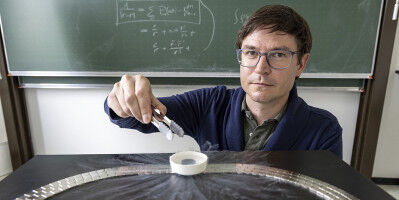
Innsbruck researchers simulated the energy bonds of molecular hydrogen and lithium hydride. Fotonachweis: IQOQI Innsbruck/Harald Ritsch
An international group of researchers has achieved the world's first multi-qubit demonstration of a quantum chemistry calculation performed on a system of trapped ions, one of the leading hardware platforms in the race to develop a universal quantum computer. The research, led by Cornelius Hempel and Thomas Monz, explores a promising pathway for developing effective ways to model chemical bonds and reactions using quantum computers. "Even the largest supercomputers are struggling to model accurately anything but the most basic chemistry. Quantum computers simulating nature, however, unlock a whole new way of understanding matter. They will provide us with a new tool to solve problems in materials science, medicine and industrial chemistry using simulations", says Cornelius Hempel, now at the University of Sydney. With quantum computing still in its infancy, it remains unclear exactly what problems these devices will be most effective at solving, but most experts agree that quantum chemistry is going to be one of the first 'killer apps' of this emergent technology. Broad application for quantum chemistry.
TO READ THIS ARTICLE, CREATE YOUR ACCOUNT
And extend your reading, free of charge and with no commitment.