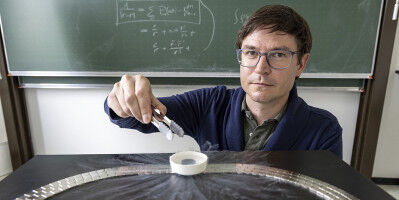
Caption: The artificial agent uses optical elements such as this beam splitter to construct new and optimized experiments. Photo credit: Harald Ritsch
On the way to an intelligent laboratory, physicists from Innsbruck and Vienna present an artificial agent that autonomously designs quantum experiments. In initial experiments, the system has independently (re)discovered experimental techniques that are nowadays standard in modern quantum optical laboratories. This shows how machines could play a more creative role in research in the future. We carry smartphones in our pockets, the streets are dotted with semi-autonomous cars, but in the research laboratory experiments are still being designed by people. However, this could change soon. In the group of Innsbruck physicist Hans Briegel, researchers broach the question to what extent machines can carry out research autonomously. For this purpose, they use the projective simulation model for artificial intelligence, developed by the group, to enable a machine to learn and act creatively.
TO READ THIS ARTICLE, CREATE YOUR ACCOUNT
And extend your reading, free of charge and with no commitment.