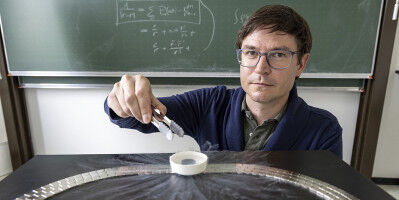
Physicists use an interferometer to test whether standard quantum mechanics is correct, or whether a more complex version is required. They used the interferometer to send photons around a loop in opposite directions. In this way, photons travelling in one direction interact with objects inside the loop in one order, while photons travelling the opposite direction interact with objects in the opposite order. The physicists were interested whether the order of the interaction mattered, as predicted by alternative versions of quantum mechanics (Copyright: MSc. Jonas Schmöle, Faculty of Physics, University of Vienna).
Physicists have searched for deviations from standard quantum mechanics, testing whether quantum mechanics requires a more complex set of mathematical rules. To do so a research team led by Philip Walther at the University of Vienna designed a new photonic experiment using exotic metamaterials, which were fabricated at the University of California Berkeley. Their experiment supports standard quantum mechanics and allows the scientists to place bounds on alternative quantum theories. The results, which are published in "Nature Communications", could help to guide theoretical work in a search for a more general version of quantum mechanics. Quantum mechanics is based on a set of mathematical rules, describing how the quantum world works. These rules predict, for example, how electrons orbit a nucleus in an atom, and how an atom can absorb photons, particles of light. The standard rules of quantum mechanics work extremely well, but, given that there are still open questions regarding the interpretation of quantum mechanics, scientists are not sure whether the current rules are the final story. This has motivated some scientists to develop alternative versions of the mathematical rules, which are able to properly explain the results of past experiments, but provide new insight into the underlying structure of quantum mechanics. Some of these alternative mathematical rules even predict new effects, which require new experimental tests. Everyday experience of mathematical rules
TO READ THIS ARTICLE, CREATE YOUR ACCOUNT
And extend your reading, free of charge and with no commitment.