





news
University of Innsbruck
Results 1 - 20 of 142.
Astronomy & Space - Physics - 11.03.2026

An international research team including Stefan Kimeswenger, astrophysicist at the University of Innsbruck, has tested a new approach to studying Earth-like exoplanets. The idea is to combine a large, earth-based telescope with a "sunshade" orbiting in space. How likely are habitable exoplanets, i.e. Earth-like planets outside our solar system? This is the question behind large-scale feasibility study , a project in which Nobel Prize winners Michel Mayor and John Mather were among those involved.
Astronomy & Space - Physics - 03.03.2026
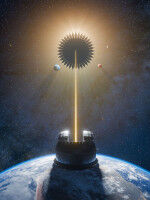
Observing exoplanets poses a number of challenges. In particular, planets that resemble the Earth are very difficult to study, as they only shine faintly and are outshone by their associated star. Now an international research team including Stefan Kimeswenger, astrophysicist at the University of Innsbruck, has investigated a new approach: a large, Earth-based telescope is to be combined with a "sunshade" orbiting in space that specifically blocks out the star's light.
Materials Science - 04.02.2026
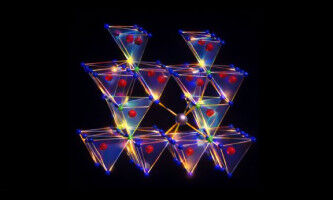
An international collaboration involving researchers from the University of Innsbruck has developed a novel luminescent material that enables particularly robust and precise optical temperature sensing across an exceptionally broad temperature range. Optical luminescence thermometry has been gaining increasing importance, as it allows contactless temperature measurement even under extreme conditions.
Physics - Chemistry - 20.01.2026
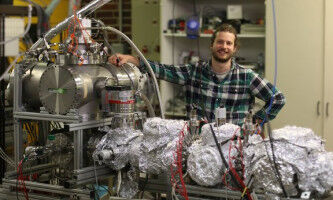
At the Department of Ion Physics and Applied Physics at the University of Innsbruck, a research team has succeeded for the first time in storing electrically charged helium nanodroplets in an ion trap for up to one minute. This extends the time window for experiments with these extremely cold "mini-laboratories" by a factor of 10,000 compared to previous methods - and opens up new possibilities for basic research in physics and chemistry.
Environment - Earth Sciences - 13.01.2026
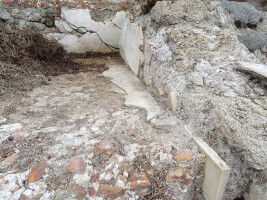
A new study by researchers from Mainz, Oxford, Berlin and Innsbruck shows that Pompeii's early baths were much less hygienic than long assumed. Geochemical analyses of lime deposits from the city's wells and pools reveal severe contamination and shed light on the ancient water supply in Pompeii. Innsbruck geologist Christoph Spötl was involved in the study published in the scientific journal PNAS.
Health - Campus - 11.11.2025

Research project on motor abnormalities in children provides practical solutions Motor abnormalities in children are often not recognized as such. This is shown by a study in 25 Tyrolean kindergartens with over 750 children. In a two-stage test, almost 5 percent of the children showed deficits in their motor development.
Earth Sciences - Environment - 21.10.2025
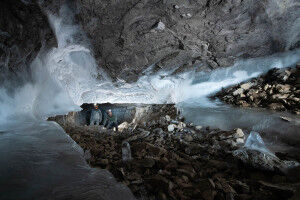
In a remote cave in northern Greenland, a research team led by geologists Gina Moseley, Gabriella Koltai and Jonathan Baker from the University of Innsbruck has discovered traces of a significantly warmer Arctic. The cave deposits show that the region was free of permafrost millions of years ago and reacted sensitively to rising temperatures.
Physics - 14.08.2025

Physicists at the University of Innsbruck have observed a quantum system that, contrary to expectations and although new energy was constantly being added, did not heat up. The phenomenon known as "dynamic many-body localization" shows how quantum coherence prevents the absorption of energy. The results have now been published in the journal Science .
Physics - 10.07.2025

A research team led by Gregor Weihs has developed a method for the deliberate control of dark excitons in quantum dots. Using chirped laser pulses and a magnetic field, the physicists succeeded in controlling these optically inactive quasiparticles and harnessing their unique properties for the storage and processing of quantum states.
Physics - Computer Science - 04.06.2025

An international team led by Innsbruck quantum physicist Peter Zoller, together with the US company QuEra Computing, has directly observed a gauge field theory similar to models from particle physics in a two-dimensional analog quantum simulator for the first time. The study, published in Nature, opens up new possibilities for research into fundamental physical phenomena.
Physics - Computer Science - 28.05.2025

Scientists led by Hanns-Christoph Nägerl have observed anyons - quasiparticles that differ from the familiar fermions and bosons - in a one-dimensional quantum system for the first time. The results, published in Nature , may contribute to a better understanding of quantum matter and its potential applications.
Life Sciences - Health - 12.05.2025

Voltage-gated calcium channels are associated with numerous diseases. A new research group led by Nadine Ortner from the Institute of Pharmacy at the University of Innsbruck is now focusing on gene mutations that impair the function of a specific channel subtype known as CaV1. The five-person interdisciplinary team is funded by the Austrian Science Fund (FWF) with 1.64 million euros.
Astronomy & Space - 10.04.2025

A recent study reports the first direct observation of merging star clusters in the nuclear region of dwarf galaxies in Nature . The team was studying observations from the Hubble Space telescope, which were led by Francine Marleau from the University of Innsbruck. This detection confirms the feasibility of this formation route for nuclei in dwarf galaxies, which has long been debated.
Environment - 10.04.2025

The preservation of at least some glacier ice in the Tyrolean Alps depends largely on whether the global temperature limit of +1.5 °C is maintained. If the global average temperature rises above this, all glaciers in the region can be expected to disappear completely - many of them within the next few years.
Physics - 04.04.2025

Quantum states can only be prepared and observed under highly controlled conditions. A research team from Innsbruck, Austria, has now succeeded in creating so-called hot Schrödinger cat states in a superconducting microwave resonator. The study, recently published in Science Advances , shows that quantum phenomena can also be observed and used in less perfect, warmer conditions.
Physics - Computer Science - 25.03.2025

Research into elementary particles and their interactions is of central importance for our understanding of the universe. A team from the Universities of Innsbruck and Waterloo shows how a new type of quantum computer opens a door into the world of particle physics. The standard model of particle physics provides the best description to date of the forces and particles that make up our world.
Computer Science - Physics - 13.03.2025

An international research team including the group led by Tracy Northup has developed the first operating system designed for quantum networks: QNodeOS . The research, published in Nature , marks a major step forward in transforming quantum networking from a theoretical concept to a practical technology that could revolutionize the future of the internet. "The goal of our research is to bring quantum network technology to all.
Physics - Innovation - 10.03.2025

Manuele Landini from the University of Innsbruck was part of an international team led by researchers at CNR Nanotec in Lecce, Italy, that has demonstrated the emergence of a supersolid phase of matter in a photonic crystal polariton condensate. This pioneering work, published in Nature , introduces a new platform for exploring supersolidity beyond traditional ultracold atomic systems.
Life Sciences - Health - 17.02.2025

What happens in the brain as we age? Might it be at all possible to rejuvenate nerve cells? Seeking answers to these questions, a research group led by Frank Edenhofer at the Department of Molecular Biology has succeeded for the first time in observing mini-brains age. As we get older, our brain ages along with us: we find learning new things more difficult and our memory occasionally fails us.
Physics - Computer Science - 24.01.2025

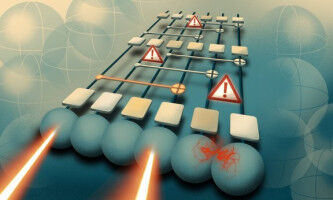
Various methods are used to correct errors in quantum computers. Not all'operations can be implemented equally well with different correction codes. Therefore, a research team from the University of Innsbruck, together with a team from RWTH Aachen and Forschungszentrum Jülich, has developed a method and implemented it experimentally for the first time, with which a quantum computer can switch back and forth between two correction codes and thus perform all computing operations protected against errors.


