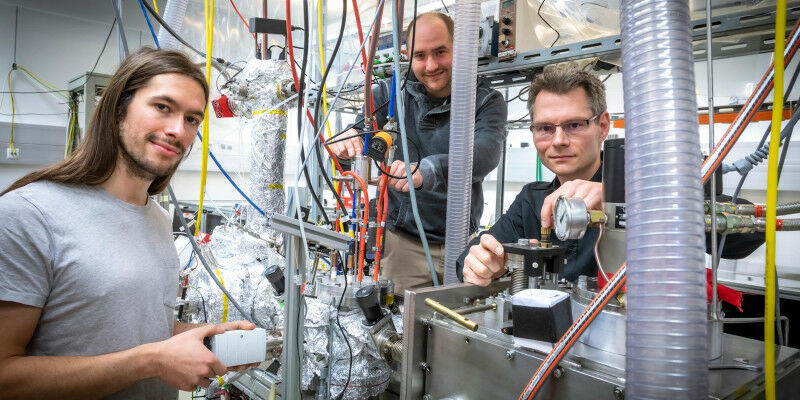
 Their experiments were part of the success of the research: Pascal Heim, Stefan Cesnik and Markus Koch. (f. l.)
Their experiments were part of the success of the research: Pascal Heim, Stefan Cesnik and Markus Koch. (f. l. Lunghammer - TU Graz By Christoph Pelzl - Researchers from Graz University of Technology and the University of Vienna are demonstrating for the first time how the energy flow between strongly interacting molecular states can be better described. Additional at the end of the text Since the 1990s, femtochemistry has been researching ultrafast processes at the molecular level. In the last few years, the research group Femtosecond Dynamics at TU Graz's Institute of Experimental Physics has been able to achieve a number of successes in the area of light-matter interaction. "A precise understanding of the processes triggered by photoexcitation in molecules is, for example, a prerequisite for the development of sustainable technologies that enable an energy supply based on solar energy," says Markus Koch, the head of the working group. As an example, he cites photocatalysis, which helps to convert sunlight into chemical energy with advantages in terms of long-term storage and energy density when compared to the generation of electrical energy via photovoltaics.
TO READ THIS ARTICLE, CREATE YOUR ACCOUNT
And extend your reading, free of charge and with no commitment.
Your Benefits
- Access to all content
- Receive newsmails for news and jobs
- Post ads