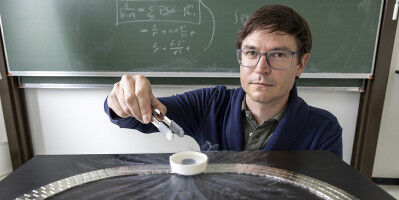
Caption: An ultracold gas of atoms trapped in an optical lattice is particularly well suited for its experimental realization. Photo credit: IQOQI Innsbruck / Harald Ritsch
Physicists demonstrate how heating up a quantum system can be used as a universal probe for exotic states of matter. In physical sciences, certain quantities appear as integer multiples of fundamental and indivisible elements. This quantization of physical quantities, which is at the heart of our description of Nature, made its way through the centuries, as evidenced by the antique concept of the atom. Importantly, the discovery of quantized quantities has often been associated with a revolution in our understanding and appreciation of Nature's law, a striking example being the quantization of light in terms of photons, which led to our contemporary (quantum-mechanical) description of the microscopic world. In an article published in Science Advances , an international team led by Prof. Nathan Goldman (ULB, Brussels) predicts a novel form of quantization law, which involves a distinct type of physical observable: the heating rate of a quantum system upon external shaking. In order to understand this concept, let us first consider a simpler analogous picture: When an ice cube is placed into a micro-wave oven, the latter excites the water molecules, hence leading to a progressive melting of the ice; during this heating process, the number of molecules that form the ice decreases in time, a process which can be quantified by a heating rate. In the present article, the authors demonstrate how, under specific circumstances, such heating rates must satisfy an elegant and precise quantization law .
UM DIESEN ARTIKEL ZU LESEN, ERSTELLEN SIE IHR KONTO
Und verlängern Sie Ihre Lektüre, kostenlos und unverbindlich.