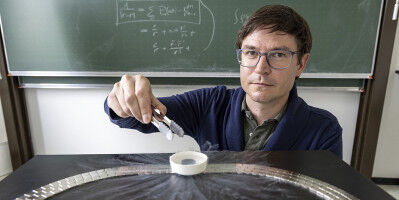
Modern fabrication methods allow to make atomically thin nanomasks which prove to be sufficiently robust for experiments in molecular quantum optics (Copyright: Quantennanophysik, Fakultät für Physik, Universität Wien; Bild-Design: Christian Knobloch).
Quantum physics tell us that even massive particles can behave like waves, as if they could be in several places at once. This phenomenon is typically proven in the diffraction of a matter wave at a grating. In a European collaboration, researchers carried this idea to the extreme and observed the delocalization of molecules at the thinnest possible grating, a mask milled into a single layer of atoms. The presented experiments explore the technical limits of matter wave technologies and respond to a famous Gedanken experiment by Einstein and Bohr of almost 80 years ago. The results are published in the journal "Nature Nanotechnology". The quantum mechanical wave nature of matter is the basis for a number of modern technologies like high resolution electron microscopy, neutron-based studies on solid state materials or highly sensitive inertial sensors working with atoms. The research in the group around Prof. Markus Arndt at the University of Vienna is focused on how one can extend such technologies to large molecules and cluster.
TO READ THIS ARTICLE, CREATE YOUR ACCOUNT
And extend your reading, free of charge and with no commitment.