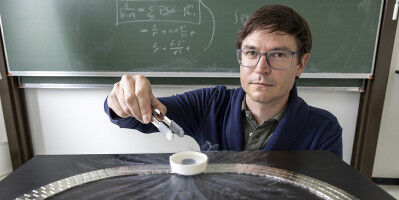
Caption: The Erbium Team (from left): Kiyotaka Aikawa, Albert Frisch, Simon Baier, Michael Mark, and Francesca Ferlaino (not pictured: Cornelis Ravensbergen) Photo credit: University of Innsbruck
In Innsbruck a team of physicists led by Francesca Ferlaino experimentally observed how the anisotropic properties of particles deform the Fermi surface in a quantum gas. The work published in Science provides the basis for future studies on how the geometry of particle interactions may influence the properties of a quantum system. How a system behaves is determined by its interaction properties. An important concept in condensed matter physics for describing the energy distribution of electrons in solids is the Fermi surface, named for Italian physicist Enrico Fermi. The existence of the Fermi surface is a direct consequence of the Pauli exclusion principle, which forbids two identical fermions from occupying the same quantum state simultaneously. Energetically, the Fermi surface divides filled energy levels from the empty ones. For electrons and other fermionic particles with isotropic interactions - identical properties in all directions - the Fermi surface is spherical. "This is the normal case in nature and the basis for many physical phenomena," says Francesca Ferlaino from the Institute for Experimental Physics at the University of Innsbruck. "When the particle interaction is anisotropic - meaning directionally dependent - the physical behavior of a system is completely altered. Introducing anisotropic interactions can deform the Fermi surface and it is predicted to assume an ellipsoidal shape." The deformation of the Fermi surface is caused by the interplay between strong magnetic interaction and the Pauli exclusion principle. Francesca Ferlaino and her experimental research group have now been able to show such a deformation for the first time. Simulation in ultracold quantum gas
UM DIESEN ARTIKEL ZU LESEN, ERSTELLEN SIE IHR KONTO
Und verlängern Sie Ihre Lektüre, kostenlos und unverbindlich.