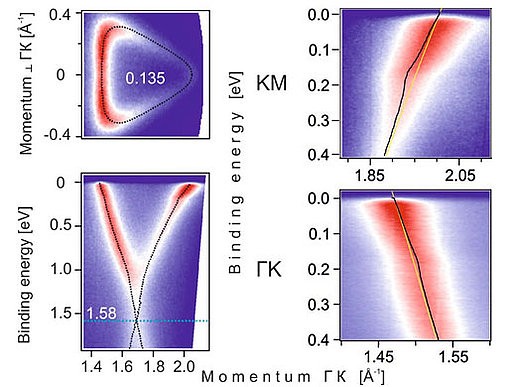
ARPES measurements of Calcium doped graphene. Left: the Fermi surface of graphene (top) and the Dirac cone (bottom). Right: The kink in the spectral function in the two crystallographic main directions. The scientists analysed the strength of the kink in order to estimate the superconducting critical temperature. (Copyright: A. Grüneis and A.V. Fedorov)
Whenever a new material is discovered, scientists are eager to find out whether or not it can be superconducting. This applies particularly to the wonder material graphene. Now, an international team around researchers at the University of Vienna unveiled the superconducting pairing mechanism in Calcium doped graphene using the ARPES method. Their results are published in the reputed journal Nature. Superconducting materials exhibit an invaluable feature when cooled below a critical temperature - they allow the transport of an electric current without loss. Superconductivity is based on the fact that in certain materials electrons can pair up which - at a higher temperature - would otherwise repel each other. Scientists from the Electronic Properties of Materials Group at the Faculty of Physics (University of Vienna) and their collaboration partners teamed up to uncover the potential superconducting coupling mechanism of the wonder material graphene. Graphene, a single-atom thick layer of carbon atoms was discovered in 2004 and is regarded as one of the most amazing and versatile substances available to mankind. The impact of the first real two-dimensional material is so significant that a Nobel Prize was awarded for its discovery. Until recently, there were no experimental reports of superconductivity in graphene although its close relatives, graphite and fullerenes can be made superconducting by intentionally introducing electrons in the material (doping). The ARPES method - how light sheds light on superconductivity
UM DIESEN ARTIKEL ZU LESEN, ERSTELLEN SIE IHR KONTO
Und verlängern Sie Ihre Lektüre, kostenlos und unverbindlich.