



news
Graz University of Technology
Results 201 - 220 of 303.
Environment - 16.12.2019

By Udo Bachhiesl, Robert Gaugl, Karthik Subramanya Bhat, Christopher Pansi The effects of climate change are becoming increasingly noticeable and therefore a transformation of our energy system is becoming more and more urgent. The fight against climate change is a global challenge and the electricity sector plays a key role in this transformation process.
Life Sciences - Health - 16.12.2019
New Horizons for Arterial Spin Labeling
Over the last two decades researchers have been working on a contrast-agent free magnetic resonance imaging (MRI) method called Arterial Spin Labeling (ASL) for detecting blood flow changes within the brain and other organs. Recent improvements in imaging hardware, new strategies for efficient data sampling and sophisticated reconstruction algorithms have now brought the application out of research into clinical practice.
Materials Science - Innovation - 11.12.2019

By Birgit Baustädter 3D printing is the manufacturing technique of the future. And these are not just empty words: the approach's significance is reflected in numerous examples from a wide variety of disciplines. This article has just been published in our research magazine TU Graz research. You can read or download the latest issue directly as an e-paper.
Innovation - Computer Science - 02.12.2019

By Christoph Pelzl Dieter Schmalstieg, a researcher at Graz University of Technology, is working on a method combining the advantages of cloud computing and virtual reality. This method will allow computer games to be displayed on inexpensive VR headsets in unsurpassed quality. Streaming services, such as Netflix or Amazon Prime, are widely used.
Physics - Materials Science - 13.11.2019

A team from Graz University of Technology succeeded in using the FEBID method to produce complex 3D-printed nano-components for the first time without additional support structures. Additional pictures for download at the end of the text In the nanometer range, complex, free-standing 3D architectures are very difficult to produce in a single step due to the required precision.
Computer Science - 13.11.2019

By Birgit Baustädter At the beginning of 2019, an international research team led by Daniel Gruss, Michael Schwarz and Moritz Lipp from TU Graz discovered the processor loophole ZombieLoad. Since then there has been a software patch and new processors. But with a new variant of the old attack these are no longer safe either.
Innovation - Physics - 13.11.2019

By Christoph Pelzl A team from Graz University of Technology succeeded in using the FEBID method to produce complex 3D-printed nano-components for the first time without additional support structures. Additional at the end of the text In the nanometer range, complex, free-standing 3D architectures are very difficult to produce in a single step due to the required precision.
Innovation - Health - 12.11.2019

By Christoph Pelzl Med Uni Graz, TU Graz and Uni Graz yesterday honoured those scientists who have pioneered research in the last two years with their inventions and patents. Since 2015, the Medical University of Graz, Graz University of Technology and the University of Graz have been honouring particularly "inventive" researchers in a joint ceremony every two years.
Physics - Materials Science - 11.11.2019

By Birgit Baustädter Materials researcher Florian Lackner "wraps" highly reactive alkali metal atoms in gold and examines them in his laser laboratory. A job he dreamed of when he was a child. "What I'm doing now is exactly what I've always wanted to do." Florian Lackner has achieved what many wish for.
Life Sciences - Environment - 06.11.2019

By Barbara Gigler Research team from Graz develops biological methods to improve the shelf life of fruit and vegetables. Additional at the end of the text The crops have been harvested. Now it is important to store the various crops well and to preserve them as long and as carefully as possible. Post-harvest losses due to spoilage, however, represent a significant problem along the supply chain and lead to profit losses in the millions.
Health - Life Sciences - 11.10.2019

By Christoph Pelzl The new method developed at TU Graz and the University of Vienna is leading to a better understanding of natural protein modifications and improved protein therapeutics. Additional at the end of the text Some of the body's proteins are not just made up of amino acids, they are also 'decorated' with lipid chains, which significantly influence the biological functions of the protein.
Astronomy & Space - Physics - 10.10.2019

By Birgit Baustädter Did you know that the first Austrian satellite to go into space was built in TU Graz's labs? TUGSAT-1 has been observing stars for more than six years - and it's not the only object made in Graz that is hurtling through space. "The night after the launch I was lying awake in bed and I thought to myself: amazing! This is something that I held in my hands and now it's flying through space," recalls Otto Koudelka, sitting at a glass conference table at the Inffeldgasse site in Graz.
Materials Science - 07.10.2019
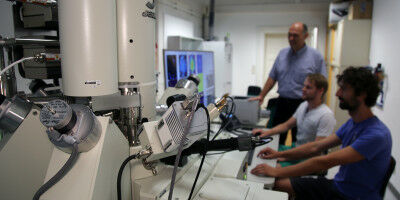
By Birgit Baustädter In chemical analysis, when electron microscopes reach their limits, the field emission microprobe steps in. With this equipment, taking analysis down to the next level of magnitude is no problem. The wafer-thin black flake shines like a flattened precious stone. The flake is locked in a silver sample container sitting on a clean tray waiting to be pushed into a large machine on the opposite side of the lab.
Earth Sciences - Astronomy & Space - 11.09.2019

By Birgit Baustädter Torsten Mayer-Gürr surveys the Earth. He may work in an office in Steyrergasse in Graz, but his measuring device flies more than 400 kilometres overhead. Over 400 kilometres above us in the heavens, Tom and Jerry chased each other for years. One of them always out in front, the other in hot pursuit at a varying distance.
Transport - Environment - 13.08.2019

By Christoph Pelzl Researchers at TU Graz are working together with European partners on new possibilities of measuring vehicle emissions. Today, air pollution is one of the biggest challenges facing European cities. As part of the Horizon 2020 research project CARES (City Air Remote Emission Sensing), an international research consortium is working on new contactless exhaust measurement methods that will enable municipalities to take emission-reducing measures.
Materials Science - Physics - 31.07.2019

By Susanne Eigner An international team involving researchers from TU Graz has published research into a new solid-state electrolyte for batteries. The material exhibits one of the fastest lithium mobility processes ever measured in a lithium-ion conductor. Solid-state batteries are currently the most promising technology helping to pave the way for the breakthrough of electric mobility.
Architecture & Buildings - Environment - 18.07.2019

By Ute Wiedner Is computer-aided design and construction with natural materials a contradiction in terms? Not for TU Graz architect Urs Hirschberg, who sees digital planning as an opportunity for sustainable architecture. News+Stories: You conduct research in the field of digital construction, or to put it more precisely, "augmented architecture".
Physics - Electroengineering - 26.06.2019

By Christoph Pelzl For the first time ever, physicists have been able to change the magnetic moment of a material using a light wave within one femtosecond - the fastest magnetic event ever observed. Additional at the end of the text Electronic properties of materials can be directly influenced via light absorption in under a femtosecond (10 -15 seconds), which is regarded as the limit of the maximum achievable speed of electronic circuits.
Environment - Innovation - 14.06.2019

The growth in renewable energy technologies will render future energy systems more complex and volatile. So advanced control strategies are required to ensure their optimal operation. For this reason, the Bioenergy 2020+ competence centre established a working group focusing on automation and control in close cooperation with the Institute of Automation and Control at TU Graz.
Earth Sciences - Environment - 13.06.2019

By Christoph Pelzl Researchers at TU Graz calculate the most accurate gravity field determination of the Earth using 1.16 billion satellite measurements. This yields valuable knowledge for climate research. The Earth's gravity fluctuates from place to place. Geodesists use this phenomenon to observe geodynamic and climatological processes.


