



news
Physics
Results 321 - 340 of 555.
Physics - 06.05.2019

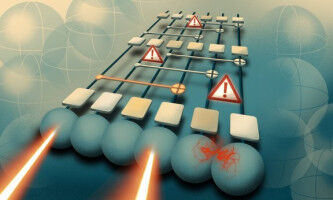
A novel material that consists of a single sheet of carbon atoms could lead to new designs for optical quantum computers. Physicists from the University of Vienna and the Institute of Photonic Sciences in Barcelona have shown that tailored graphene structures enable single photons to interact with each other.
Astronomy & Space - Physics - 24.04.2019

Researchers show young stars rapidly destroy Earth-like Nitrogen dominated atmospheres The discoveries of thousands of planets orbiting stars outside our solar system has made questions about the potential for life to form on these planets fundamentally important in modern science. Fundamentally important for the habitability of a planet is whether or not it can hold onto an atmosphere, which requires that the atmosphere is not completely lost early in the lifetime of the planet.
Physics - 24.04.2019

The human eye is particularly sensitive to green, but less sensitive to blue and red. Chemists led by Hubert Huppertz at the University of Innsbruck have now developed a new red phosphor whose light is well perceived by the eye. This increases the light yield of white LEDs by around one sixth, which can significantly improve the energy efficiency of lighting systems.
Chemistry - Physics - 04.04.2019

By Christoph Pelzl Researchers at TU Graz describe the effects which occur upon evaporation of vanadium compounds in Chemical Science. Improvements for the development of SCR catalysts may be based on their results. Researchers at the Institute of Experimental Physics at TU Graz have investigated the detailed structure and thermodynamic behaviour of nano-cluster structures since 2012.
Physics - 29.03.2019

When a particle is completely isolated from its environment, the laws of quantum physics start to play a crucial role. One important requirement to see quantum effects is to remove all thermal energy from the particle motion, i.e. to cool it as close as possible to absolute zero temperature.
Physics - 05.03.2019

The concept of the laser can be reversed: the perfect light source then becomes the perfect light absorber. Scientists at TU Wien have found a way to build such an anti-laser, based on random scattering. The laser is the perfect light source: As long as it is provided with energy, it generates light of a specific, well-defined colour.
Physics - Computer Science - 01.03.2019

BeyondC research project with partners from Austria and Germany starts in March The recently granted collaboration project "Quantum Information Systems Beyond Classical Capabilities (BeyondC)" coordinated by the University of Vienna will exploit the unique features of quantum science to go beyond the capabilities of classical technology.
Physics - Electroengineering - 21.02.2019

Physicists have discovered a new effect, which makes it possible to create excellent thermal insulators which conduct electricity. Such materials can be used to convert waste heat into electrical energy. Every day we lose valuable energy in the form of waste heat - in technical devices at home, but also in large energy systems.
Physics - 18.02.2019

Currently, there is no precise computation method to describe superconducting materials. TU Wien has now made a major advance towards achieving this goal and, at the same time, has furthered an understanding of why conventional materials only become superconducting at around -200°C Why does it always have to be so cold? We now know of a whole range of materials that ' under certain conditions ' conduct electrical current entirely without resistance.
Physics - Computer Science - 01.02.2019

Researchers determine the performance of multi-dimensional bits Quantum computers are more powerful than classical computers since they work with coherent "quantum bits" instead of ordinary zeroes and ones. But what if the laws of nature were different from what we think today - could there be even more efficient "science fiction computers"- Researchers from the Austrian Academy of Sciences and the University of Vienna have now shown that this is not possible - as long as those machines satisfy the same construction principles as ordinary circuits and their quantum counterparts.
Physics - 30.01.2019

Researchers at the University of Vienna study the relevance of quantum reference frames for the symmetries of the world According to one of the most fundamental principles in physics, an observer on a moving train uses the same laws to describe a ball on the platform as an observer standing on the platform - physical laws are independent on the choice of a reference frame.
Physics - 28.01.2019

New findings are changing the way we think about superconductivity. Experiments at TU Wien (Vienna) underline the special role of immobile charge carriers, acting as a 'glue', which makes superconductivity possible. Every standard cable, every wire, every electronic device has some electric resistance.
Physics - Chemistry - 27.12.2018

Why is water densest at around 4 degrees Celsius' Why does ice float? Why does heavy water have a different melting point compared to normal water? Why do snowflakes have a six-fold symmetry? A collaborative study of researchers from the École Polytechnique Fédérale de Lausanne, the University of Göttingen and the University of Vienna and just published in the Proceedings of the National Academy of Sciences of the USA, provides physical insights into these questions by marrying data-driven machine learning techniques and quantum mechanics.
Physics - 19.12.2018

[ Florian Aigner "Topological materials" are very interesting for technology, but difficult to study. TU Wien (Vienna) and the University of Science and Technology in China are presenting new approaches. Electrons are not just little spheres, bouncing through a material like a rubber ball. The laws of quantum physics tell us that electrons behave like waves.
Environment - Physics - 18.12.2018

By Hermann Schranzhofer, Andreas Heinz The working group "Energy efficient buildings" at the Institute of Thermal Engineering has been working in this area for about 20 years. The scope ranges from the development of individual building technology components to the design and optimization of complex overall energy systems for the heating and cooling of buildings and entire residential areas.
Physics - Chemistry - 12.12.2018

By Birgit Baustädter TU Graz operates two beamlines at the 'Elettra Sincrotrone Trieste' research facility in which structures and properties of materials can be investigated at the tiniest scale. The circular route around the storage ring at the centre of the Elettra Sincrotrone Trieste research facility high in the mountains above the Italian harbour city of Trieste is 280 metres long.
Physics - Chemistry - 11.12.2018

[ Florian Aigner "Frequency combs" are optimally suited for chemical sensors. A revolutionary technology developed at TU Wien (Vienna) now produces these laser frequencies in a much easier and more robust way. Most lasers have only one color. All the photons it emits have exactly the same wavelength.
Physics - Electroengineering - 21.11.2018

Innsbruck quantum physicists have constructed a diode for magnetic fields and then tested it in the laboratory. The device, developed by the research groups led by the theorist Oriol Romero-Isart and the experimental physicist Gerhard Kirchmair, could open up a number of new applications. Electric diodes are essential electronic components that conduct electricity in one direction but prevent conduction in the opposite one.
Physics - Materials Science - 13.11.2018

Research team at TU Graz discovers atomic-level processes which can provide new approaches to improving material properties. Aluminium alloys have unique material properties and are indispensable materials in aircraft manufacturing and space technology. With the help of high-resolution electron tomography, researchers at TU Graz have for the first time been able to decode mechanisms crucial for understanding these properties.
Physics - 08.11.2018

When quantum particles swirl about, they still obey universal laws. Different quantum systems can show the same behaviour - this has been demonstrated by two different experiments at TU Wien and Heidelberg University. Some things are so complicated that it is completely impossible to precisely calculate them.


