


news 2025
« BACK
 A Clear Signal Emerging from Quantum Noise
 Water molecules in motion: Surprising dynamics on 2D materials
 Charging Particles to Overcome the Fundamental Limits of Acoustic Levitation
 Trapping Particles to Explain Lightning
 A New Kind of Copper from the Research Reactor
 A new approach links quantum physics and gravitation
 Reaching for the (Quantum) Scars
 The crystal that makes clouds rain
 The Power of Geckos: Puzzle of Large Molecules Solved
 How constant is the fine structure constant?
 Invisible secret codes from the 3D printer
 The Quantum Door Mystery: Electrons That Can’t Find the Exit
 Photosynthesis: old theorem of chemical biology disproved
 Supercapacitors precisely illuminated
 Finding treasures with physics: the fingerprint matrix
 Innovative transistors for quantum chips
 New type of time crystals discovered
 TU Wien develops a microscope for ultra-sensitive samples
 A quantum gas that cannot be heated
 New materials: From the computer straight to applications
Physics
Results 1 - 20 of 67.
Physics - 16.12.2025
Researchers at TU Wien and the Okinawa Institute of Science and Technology (OIST) have demonstrated an unexpected effect: in a quantum system that is highly disordered, coherent microwave radiation can suddenly emerge. Two candles emit twice as much light as one. And ten candles have ten times the intensity.
Materials Science - Physics - 02.12.2025
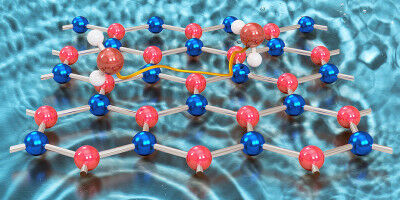
Instead of jumping, water molecules walk: Graz University of Technology and the University of Surrey show how water moves in surprisingly different ways on ultra-thin materials. In a study published in Nature Communications , researchers from Graz University of Technology (TU Graz) and the University of Surrey tested two ultra-thin, sheet-like materials with a honeycomb structure - graphene and hexagonal boron nitride (h-BN).
Physics - 01.12.2025
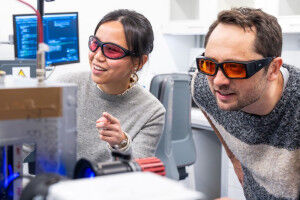
Physicists overcome a fundamental limitation of acoustic levitation with charge Physicists from the Institute of Science and Technology Austria (ISTA) have developed a method to acoustically levitate objects while keeping them physically separated using charge. Their results, published in PNAS , could find applications in materials science, robotics, and microengineering .
Physics - 20.11.2025
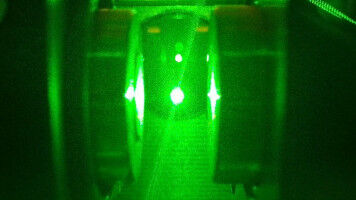
Using lasers as tweezers to understand cloud electrification might sound like science fiction, but at the Institute of Science and Technology Austria (ISTA), it is a reality. By trapping and charging micron-sized particles with lasers, researchers can now observe their charging and discharging dynamics over time.
Chemistry - Physics - 14.11.2025
Cu-64 is a copper isotope needed for medical applications - but it is very difficult to produce. At TU Wien, researchers have now developed an alternative production method. The copper isotope Cu-64 plays an important role in medicine: it is used in imaging processes and also shows potential for cancer therapy.
Physics - Astronomy & Space - 14.11.2025
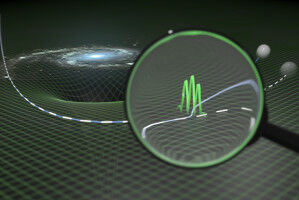
A team at TU Wien combines quantum physics and general relativity theory - and discovers striking deviations from previous results. It is something like the "Holy Grail" of physics: unifying particle physics and gravitation. The world of tiny particles is described extremely well by quantum theory, while the world of gravitation is captured by Einstein's general theory of relativity.
Physics - 13.11.2025
ISTA scientists solve complex quantum problems with the help of classical physics Quantum many-body scars are challenging our understanding of when and how quantum systems reach equilibrium. After recently demonstrating that they are more common than anticipated, researchers from the Serbyn group at the Institute of Science and Technology Austria (ISTA) have developed an algorithm to find them using classical equations of motion.
Physics - Chemistry - 03.11.2025
How silver iodide seeds ice: TU Wien researchers uncover how a tiny crystal triggers ice formation at the atomic level No one can control the weather, but certain clouds can be deliberately triggered to release rain or snow. The process, known as cloud seeding, typically involves dispersing small silver iodide particles from aircraft into clouds.
Physics - Chemistry - 28.10.2025
A puzzle in theoretical chemistry has been solved at TU Wien: a new computational method now makes it possible to calculate the forces between large molecules with unprecedented accuracy. Why can geckos walk up walls? Why does nitrogen become liquid at -196 °C? Many everyday phenomena can be explained by van der Waals forces - weak bonds between molecules that are notoriously difficult to calculate.
Physics - Chemistry - 27.10.2025
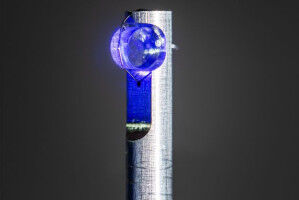
In 2024, TU Wien presented the world's first nuclear clock. Now it has been demonstrated that the technology can also be used to investigate unresolved questions in fundamental physics. Thorium atomic nuclei can be used for very specific precision measurements. This had been suspected for decades, and the search for suitable atomic nucleus states had been ongoing worldwide.
Materials Science - Physics - 22.10.2025
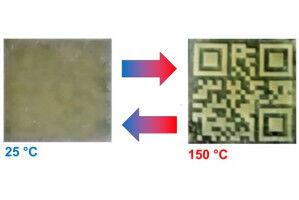
Materials that react to temperature: a development by TU Wien is now significantly expanding the possible applications of 3D printers. 3D printing is extremely practical when you want to produce small quantities of customised components. However, this technology has always had one major problem: 3D printers can only process a single material at a time.
Physics - 20.10.2025
What happens when electrons leave a solid material? This seemingly simple phenomenon has, until now, eluded accurate theoretical description. Now, researchers have found the missing piece of the puzzle. Imagine a frog sitting inside a box. The box has a large opening at a certain height. Can the frog escape? That depends on how much energy it has: if it can jump high enough, it could in principle make it out.
Life Sciences - Physics - 13.10.2025
Researchers at the Johannes Kepler University Linz, together with British colleagues, have disproved an old theorem of biochemistry. Their discovery in the field of photosynthesis could mean a long-term breakthrough towards higher agricultural yields. A large part of life on our planet is made possible by photosynthesis.
Chemistry - Physics - 10.10.2025
Synchrotron radiation provides insight into the interior of modern energy storage devices: researchers at Montanuniversität Leoben have used synchrotron radiation to uncover a central interaction in supercapacitors and precisely describe its influence on the transport of charge carriers during operation - a finding that paves the way for more powerful energy storage devices and could even contribute to the removal of perpetual chemicals from water.
Physics - Health - 02.10.2025
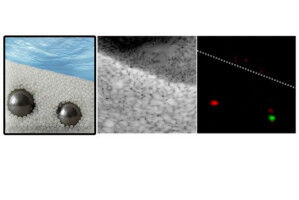
How do you find objects buried in sand or hidden in thick fog? A team from the Institut Langevin (Paris) and TU Wien (Vienna) has developed an astonishing method. Can we reveal objects that are hidden in environments completely opaque to the human eye? With conventional imaging techniques, the answer is no: a dense cloud or layer of material blocks light so completely that a simple photograph contains no information about what lies behind it.
Physics - Innovation - 23.09.2025
A new transistor technology does not require semiconductor doping - offering decisive advantages for controlling and reading quantum chips. The smaller electronic components become, the more complex their manufacture becomes. This has been a major problem for the chip industry for years.
Physics - 22.09.2025
An exotic quantum phenomenon manifests itself under conditions where one would not normally expect it, show scientists at TU Wien (Vienna). Nature has many rhythms: the seasons result from the Earth's movement around the sun, the ticking of a pendulum clock results from the oscillation of its pendulum.
Physics - 19.08.2025
How can you produce the best possible image in a microscope without destroying the sample? A new trick enables gentle imaging with maximum image quality. Everyone who ever took a photo knows the problem: if you want a detailed image, you need a lot of light. In microscopy, however, too much light is often harmful to the sample - for example, when imaging sensitive biological structures or investigating quantum particles.
Physics - 14.08.2025
Physicists at the University of Innsbruck have observed a quantum system that, contrary to expectations and although new energy was constantly being added, did not heat up. The phenomenon known as "dynamic many-body localization" shows how quantum coherence prevents the absorption of energy. The results have now been published in the journal Science .
Materials Science - Physics - 06.08.2025
New applications often require new materials. Quite often, materials are needed that do not occur naturally or have very specific properties. In order to find suitable materials for pioneering technologies, it is often not enough to follow the trial-and-error principle and systematically work through the periodic table.


