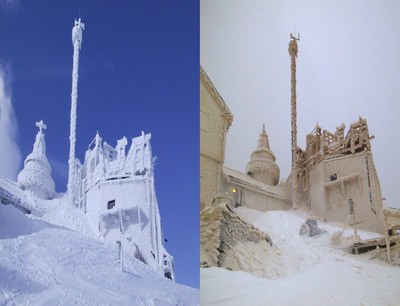
Intrusion of Saharan dust (right) detected at the Sonnblick observatory, Austria, located at 3106 m above sea level. (Photo: Ludwig Rasser)
Remote lakes are subject to the deposition of atmospheric pollutants, mineral dust, and organic matter. In a recent study published in Nature , an international group of limnologists including Prof. Ruben Sommaruga from the Institute of Ecology at the University of Innsbruck have uncovered the effect of dust on the pool of dissolved organic matter of remote alpine lakes. Photo: Intrusion of Saharan dust (right) detected at the Sonnblick observatory, Austria, located at 3106 m above sea level. (Photo: Ludwig Rasser) - Remote lakes have been recognized as sensors of global changeand are key freshwater reference sites for global-scale processes, owing to their location outside of direct human influence. However, remote lakes are also subject to the deposition of atmospheric pollutants, mineral dust, and organic matter transported by aeolian processes. In a recent study published in Nature , an international group of limnologists including Prof. Ruben Sommaruga from the Institute of Ecology and colleagues from NASA have uncovered the effect of dust, in particular from Sahara and Sahel, on the pool of dissolved organic matter (DOM) of remote alpine lakes. Dissolved organic matter (DOM) is the major form of aquatic organic carbon and has key functions in aquatic ecosystems, for example, supplying energy to support the aquatic food web and absorbing UV radiation and light, thereby regulating their penetration in the water column.
TO READ THIS ARTICLE, CREATE YOUR ACCOUNT
And extend your reading, free of charge and with no commitment.