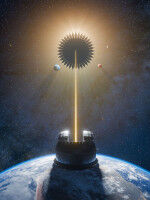
The first two Austrian satellites in space were involved in a premiere: the observation of a nova eruption, as artistically depicted here.
The first two Austrian satellites in space were involved in a premiere: the observation of a nova eruption, as artistically depicted here. Nova_by K. Ulaczyk, Warschau Universität Observatorium By Medienservice - Satellite images from the BRITE mission with the participation of researchers from TU Graz and the Universities of Innsbruck and Vienna document for the first time the complete development of a nova - from eruption to maximum brightness and burn out. The publication has now appeared in the journal Nature Astronomy. Photographic material for downloading at the end of the text Since the beginning of the BRITE Constellation in 2013 - a mission in which the first two Austrian satellites were involved - the five nanosatellites have taken millions of images. However, the recordings of a complete nova eruption are unique worldwide. The nova phenomenon. During a nova eruption, a white dwarf sucks matter from its companion star and stores this mass on its surface until the gas pressure becomes extremely high. An explosion occurs in which hydrogen is burned, creating enormous shock fronts. These shocks are much stronger than, for example, those generated by supersonic aircraft in our Earth's atmosphere. Instead of sound, therefore, an enormous burst of light and high-energy radiation is produced, such as gamma and X-ray radiation. This means that stars that could previously only be observed with telescopes can suddenly be seen with the naked eye. "But what causes a previously unimpressive star to explode?
UM DIESEN ARTIKEL ZU LESEN, ERSTELLEN SIE IHR KONTO
Und verlängern Sie Ihre Lektüre, kostenlos und unverbindlich.
Ihre Vorteile
- Zugang zu allen Inhalten
- Erhalten Sie Newsmails für Neuigkeiten und Jobs
- Anzeigen veröffentlichen