





news
Computer Science
Results 101 - 120 of 125.
Physics - Computer Science - 29.05.2018

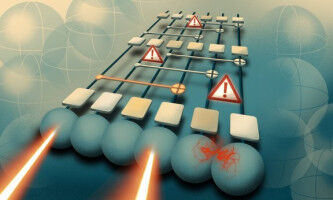
How can quantum information be transferred from one atom to another? A team of researchers from TU Wien and Harvard University has proposed using phonons - the quanta of sound. Quantum physics is on the brink of a technological breakthrough: new types of sensors, secure data transmission methods and maybe even computers could be made possible thanks to quantum technologies.
Computer Science - Economics - 03.04.2018

In the new Christian Doppler Lab TU Graz develops methodologies for the quality assurance of cyber-physical systems. Together with corporate partner AVL List, this will be illustrated using autonomous vehicles as examples. From Smart Production and the Internet of Things to Robotics, cyber-physical systems combine electronics, software and mechanics and are linked together.
Computer Science - 12.03.2018

Graphics processing units (GPUs) are used for many computationally intensive tasks. Their aging process can be slowed by clever management, as TU Wien (Vienna) and University of California (Irvine) have now shown. Graphics processing units are not only used for displaying graphics. Today, they are frequently used for particularly challenging calculations - for example in scientific research or even Bitcoin-mining.
Physics - Computer Science - 15.02.2018

Quantum entanglement is a key feature of a quantum computer. Yet, how can we verify that a quantum computer indeed incorporates a large-scale entanglement? Using conventional methods is hard since they require a large number of repeated measurements. Aleksandra Dimić from the University of Belgrade and Borivoje Dakić from the Austrian Academy of Sciences and the University of Vienna have developed a novel method where in many cases even a single experimental run suffices to prove the presence of entanglement.
Computer Science - 04.01.2018

An 10-strong international team of researchers - including researcher from TU Graz - has revealed two new vulnerabilities in computer processors: Meltdown and Spectre. PCs, server and cloud services are affected. A patch could help. Around the turn of the year speculation was rife about new, serious vulnerabilities that could affect all modern microprocessors.
Computer Science - Administration - 04.12.2017

Rowhammer attacks make use of hardware vulnerabilities in order to access computer systems. TU Graz researchers have discovered a new type of attack - and raise questions about protective mechanisms. "When a system is regarded as absolutely safe, our curiosity is awakened," explains Daniel Gruss from the Institute of Applied Information Processing and Communication Technology working group, the researcher is occupied with the security of IT systems and in particular rowhammer attacks.
Computer Science - 29.11.2017

The Computer Scientist Matteo Maffei (TU Wien) is awarded an ERC Consolidator Grant for the project "Browsec: Foundations and Tools for Client-Side Web Security" . He is working on a plugin that will make browsers safe - and is logically impossible to fool. We are hardly aware of the dangers we face when we are browsing the web.
Physics - Computer Science - 06.09.2017

Physicsts are developing quantum simulators, to help solve problems that are beyond the reach of conventional computers. However, they first need new tools to ensure that the simulators work properly. Innsbruck researchers around Rainer Blatt and Christian Roos, together with researchers from the Universities of Ulm and Strathclyde, have now implemented a new technique in the laboratory that can be used to efficiently characterize the complex states of quantum simulators.
Physics - Computer Science - 12.07.2017

Scientists at TU Wien and Würzburg University are changing our idea of the earth's magnetic field: iron alone cannot explain the concept of the geodynamo. The crucial ingredient is nickel. It only takes a simple compass to demonstrate that the earth has a magnetic field - but it is quite difficult to explain how exactly it is created.
Transport - Computer Science - 03.07.2017

By Birgit Baustädter Cooperative, autonomous driving on the motorway is the main topic of a joint project between TU Graz and the "Virtual Vehicle" competence centre. Embedded in the Campus Inffeldgasse, researchers are collaborating on developing control algorithms which calculate the right path and the right speed for selfdriving vehicles.
Life Sciences - Computer Science - 09.05.2017

A new bioinformatics tool to compare genome data has been developed by teams from the Max F. Perutz Laboratories, a joint venture of the University of Vienna and the Medical University of Vienna, together with researchers from Australia and Canada. The program called 'ModelFinder' uses a fast algorithm and allows previously not attainable new insights into evolution.
Health - Computer Science - 21.11.2016
Health trackers for rail tracks and other structures
Structural health monitoring records the current "state of health" of structures and infrastructure. This allows "illnesses" to be diagnosed at an early stage and treated. Like people, structures and infrastructure age. To prevent serious illnesses such as a heart attack, we humans, for example, can undergo health screening at regular intervals.
Computer Science - Mathematics - 04.10.2016

How does seeing work? What is a good image, and what is a bad image? How do we filter out the essential information from an image - the information we need to recognise what we see? These are key questions for brain researchers as well as computer scientists, such as Thomas Pock, who is always looking for international cooperation to achieve progress in image processing.
Computer Science - History & Archeology - 30.05.2016

Completely ordinary photos are being transformed into clean, high-resolution 3D worlds thanks to algorithms from TU Wien.
Physics - Computer Science - 23.10.2015

Theoretical physicists in Innsbruck have proposed a scalable quantum computer architecture. The new model, developed by Wolfgang Lechner, Philipp Hauke and Peter Zoller, overcomes fundamental limitations of programmability in current approaches that aim at solving real-world general optimization problems by exploiting quantum mechanics.
Physics - Computer Science - 15.01.2015
Improved interface for a quantum internet
A quantum network requires efficient interfaces over which information can be transferred from matter to light and back. In the current issue of Physical Review Letters, Innsbruck physicists led by Rainer Blatt and Tracy Northup show how this information transfer can be optimized by taking advantage of a collective quantum phenomenon.
Computer Science - 25.09.2014
Safe Cloud Computing is no Pie in the Sky
The integration of digital expert knowledge and automation of risk analyses can greatly improve software test procedures and make cloud computing more secure. This is shown by the latest results of a project of the University of Innsbruck, funded by the Austrian Science Fund FWF, on the quality assurance of security critical systems which have recently been published.
Life Sciences - Computer Science - 12.08.2014

Ion channels are involved in many physiological and pathophysiological processes throughout the human body. A young team of researchers led by pharmacologist Anna Stary-Weinzinger from the Department of Pharmacology and Toxicology, University of Vienna investigated how ion flux through a voltage gated sodium ion channel works in detail.
Physics - Computer Science - 10.07.2014
New Paths into the World of Quasiparticles
Quasiparticles can be used to explain physical phenomena in solid bodies even though they are not actual physical particles. Physicists in Innsbruck have now realized quasiparticles in a quantum system and observed quantum mechanical entanglement propagation in a many-body system.
Mathematics - Computer Science - 23.06.2014
This Sentence is Wrong
The great Viennese logician Kurt Gödel studied statements which refer to themselves - and his results shook the foundations of mathematics. "All Cretans are liars", said Epimenides, a Cretan. But this means that his statement must be a lie too. But then it is false that Cretans are liars and the statement must be true.


