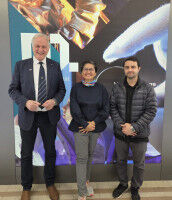
Harald Fitzek, Christian Prehal and Qamar Abbas (from left) at the SAXS facility SAXSpoint 2.0 (Anton Paar GmbH): With their work at Graz University of Technology, the researchers are providing new insights into hybrid supercapacitors.
Harald Fitzek, Christian Prehal and Qamar Abbas ( from left ) at the SAXS facility SAXSpoint 2.0 (Anton Paar GmbH): With their work at Graz University of Technology, the researchers are providing new insights into hybrid supercapacitors. Lunghammer - TU Graz By Susanne Eigner - Similar to batteries, supercapacitors are suitable for the repeated storage of electrical energy. TU Graz researchers have presented a particularly safe and sustainable variant of such a supercapacitor in Nature Communications. Additional at the end of the text Harald Fitzek, Christian Prehal and Qamar Abbas ( from left ) at the SAXS facility SAXSpoint 2.0 (Anton Paar GmbH): With their work at Graz University of Technology, the researchers are providing new insights into hybrid supercapacitors. Lunghammer - TU Graz Limited safety, sustainability and recyclability are key drawbacks of today's lithium-ion battery technology, along with restricted availability of starting materials (e.g. cobalt). In the search for alternative electrochemical energy storage systems for use in e-mobility and for storing energy from renewable sources, a combination of battery and capacitor is very promising: the "hybrid supercapacitor".
TO READ THIS ARTICLE, CREATE YOUR ACCOUNT
And extend your reading, free of charge and with no commitment.
Your Benefits
- Access to all content
- Receive newsmails for news and jobs
- Post ads