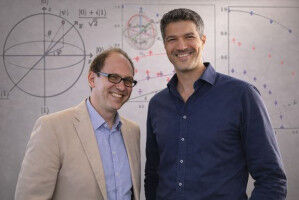
© C. Hohmann / MCQST Novel Spin-Echo-Effect If the spins of phosphorus atoms in silicon are cleverly excited with microwave pulses, a so-called spin echo signal can be detected after a certain time. Surprisingly, this spin echo does not occur only once, but a whole series of echoes can be... If the spins of phosphorus atoms in silicon are cleverly excited with microwave pulses, a so-called spin echo signal can be detected after a certain time. Surprisingly, this spin echo does not occur only once, but a whole series of echoes can be detected.
© C. Hohmann / MCQST Novel Spin-Echo-Effect If the spins of phosphorus atoms in silicon are cleverly excited with microwave pulses, a so-called spin echo signal can be detected after a certain time. Surprisingly, this spin echo does not occur only once, but a whole series of echoes can be. If the spins of phosphorus atoms in silicon are cleverly excited with microwave pulses, a so-called spin echo signal can be detected after a certain time. Surprisingly, this spin echo does not occur only once, but a whole series of echoes can be detected. (Image: C. Hohmann / MCQST) A research team from Garching and Vienna discovered a remarkable echo effect - it offers exciting new possibilities for working with quantum information. If the spins of phosphorus atoms in silicon are cleverly excited with microwave pulses, a so-called spin echo signal can be detected after a certain time. Surprisingly, this spin echo does not occur only once, but a whole series of echoes can be.
UM DIESEN ARTIKEL ZU LESEN, ERSTELLEN SIE IHR KONTO
Und verlängern Sie Ihre Lektüre, kostenlos und unverbindlich.
Ihre Vorteile
- Zugang zu allen Inhalten
- Erhalten Sie Newsmails für Neuigkeiten und Jobs
- Anzeigen veröffentlichen