1/4 images Typical sample A Perovskite thin film electrode, on a ZrO2 crystal. (Copyright: TU Wien) A Perovskite thin film electrode, on a ZrO2 crystal. (Copyright: TU Wien)
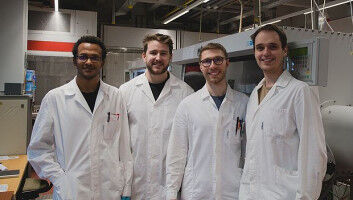
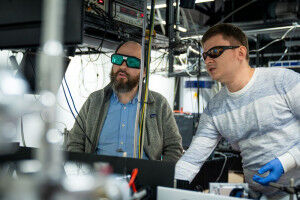
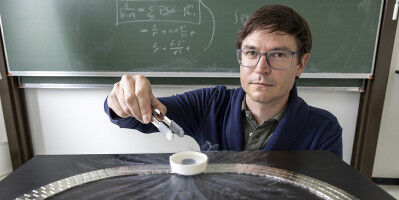
1/4 images Typical sample A Perovskite thin film electrode, on a ZrO2 crystal. (Copyright: TU Wien) A Perovskite thin film electrode, on a ZrO2 crystal. (Copyright: TU Wien) Electrochemical reactions, which will play an important role in the future of energy supply, can now be explained in detail, thanks to measurements carried out by TU Wien and DESY. 1/4 images The elektrochemistry team at TU Wien: Andreas Nenning, Harald Summerer, Alexander Opitz (left to right) (Copyright: TU Wien) 1/4 images The elektrochemistry team at TU Wien: Andreas Nenning, Harald Summerer, Alexander Opitz (left to right) (Copyright: TU Wien) 1/4 images A Perovskite thin film electrode, on a ZrO2 crystal - compared to a pen. (Copyright: TU Wien) Electrochemistry is playing an increasingly important role: Whether it is fuel cells, electrolysis or chemical energy storage, chemical reactions controlled by electric current are used. The decisive factor in all these applications is that the reactions are as fast and efficient as possible. An important step forward has now been taken by a team from TU Wien (Vienna) and DESY in Hamburg: They showed that a special material made of lanthanum, strontium, iron and oxygen can be switched back and forth between two different states: In one state the material is catalytically extremely active, in the other less so.
UM DIESEN ARTIKEL ZU LESEN, ERSTELLEN SIE IHR KONTO
Und verlängern Sie Ihre Lektüre, kostenlos und unverbindlich.