







news
Materials Science
Results 101 - 120 of 124.
Physics - Materials Science - 11.11.2019

By Birgit Baustädter Materials researcher Florian Lackner "wraps" highly reactive alkali metal atoms in gold and examines them in his laser laboratory. A job he dreamed of when he was a child. "What I'm doing now is exactly what I've always wanted to do." Florian Lackner has achieved what many wish for.
Materials Science - Chemistry - 21.10.2019

With a new process developed at TU Wien (Vienna), living cells can be integrated into fine structures created in a 3D printer - extremely fast and with very high resolution. Tissue growth and the behavior of cells can be controlled and investigated particularly well by embedding the cells in a delicate 3D framework.
Physics - Materials Science - 15.10.2019

A very special kind of light is emitted by tungsten diselenide layers. The reason for this has been unclear. Now an explanation has been found at TU Wien (Vienna). It is an exotic phenomenon that nobody was able to explain for years: when energy is supplied to a thin layer of the material tungsten diselenide, it begins to glow in a highly unusual fashion.
Materials Science - 07.10.2019
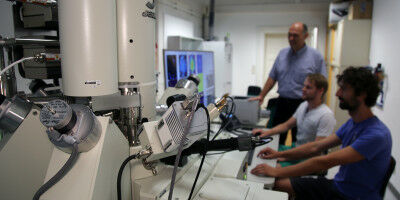
By Birgit Baustädter In chemical analysis, when electron microscopes reach their limits, the field emission microprobe steps in. With this equipment, taking analysis down to the next level of magnitude is no problem. The wafer-thin black flake shines like a flattened precious stone. The flake is locked in a silver sample container sitting on a clean tray waiting to be pushed into a large machine on the opposite side of the lab.
Physics - Materials Science - 13.08.2019

Innovative new electron spectroscopy technique pushes the limits of Nanospectroscopy for materials design In order to understand advanced materials like graphene nanostructures and optimize them for devices in nano-, optoand quantum-technology it is crucial to understand how phonons - the vibration of atoms in solids - influence the materials' properties.
Physics - Materials Science - 01.08.2019

Ultradense arrays of magnetic quanta in high-temperature superconductors The properties of high-temperature superconductors can be tailored by the introduction of artificial defects. An international research team around physicist Wolfgang Lang at the University of Vienna has succeeded in producing the world's densest complex nano arrays for anchoring flux quanta, the fluxons.
Materials Science - Physics - 31.07.2019

By Susanne Eigner An international team involving researchers from TU Graz has published research into a new solid-state electrolyte for batteries. The material exhibits one of the fastest lithium mobility processes ever measured in a lithium-ion conductor. Solid-state batteries are currently the most promising technology helping to pave the way for the breakthrough of electric mobility.
Physics - Materials Science - 25.06.2019

Effective atomic interactions in complex materials picked up by on-the-fly machine-learning At the atomic scale materials can show a rich palette of dynamic behaviour, which directly affects the physical properties of these materials. For many years, it has been a dream to describe these dynamics in complex materials at various temperatures using computer simulations.
Materials Science - Chemistry - 25.04.2019

By Christoph Pelzl Researchers at TU Graz have discovered a means of suppressing singlet oxygen formation in lithium-oxygen batteries in order to extend their useful lives. Additional at the end of the text. Since 2012, Stefan Freunberger of the Institute for Chemistry and Technology of Materials at TU Graz has been working on development of a new generation of batteries with enhanced performance and longer useful lives, and which are also cheaper to produce than current models.
Materials Science - Innovation - 09.04.2019
Pit stop for paper bags
By Werner Schandor What does industry-scale cement bag filling have in common with a pit stop in Formula 1? Filling a 25kg paper bag with cement in the factory takes about three seconds, about as long as a pit stop. But packaging and paper manufacturer Mondi reckons this is too long. They asked TU Graz to study the material flow that is at work in this process.
Materials Science - Chemistry - 13.12.2018

Conventional lithium ion batteries, such as those widely used in smartphones and notebooks, have reached performance limits. Materials chemist Freddy Kleitz from the Faculty of Chemistry of the University of Vienna and international scientists have developed a new nanostructured anode material for lithium ion batteries, which extends the capacity and cycle life of the batteries.
Physics - Materials Science - 13.11.2018

Research team at TU Graz discovers atomic-level processes which can provide new approaches to improving material properties. Aluminium alloys have unique material properties and are indispensable materials in aircraft manufacturing and space technology. With the help of high-resolution electron tomography, researchers at TU Graz have for the first time been able to decode mechanisms crucial for understanding these properties.
Chemistry - Materials Science - 12.09.2018

By Birgit Baustädter Batteries are a broad field of research. Energy storage systems of the future should be more powerful, more environmentally friendly, smaller and even safer - work is being done on this at TU Graz. Batteries are many things: cylindrical metal capsules with a plus sign at the top and a minus sign at the bottom, small black packs in our mobile phones, silver buttons in all possible sizes, invisibly integrated in our electric toothbrushes or flat and stacked up in a row in our e-vehicles.
Materials Science - Mechanical Engineering - 16.07.2018

By Werner Schandor In the CHIP project, Ceratizit Austria, TU Darmstadt, Material Center Leoben and TU Graz are improving the recording and analysis of heat flows in milling machining. With sensational results. "What is sensational about our project can be found hidden away in this rather inconspicuous chart," says Franz Haas from the Institute of Production Engineering as he points to a diagram reproducing a saw-toothed temperature progression for the period of a tenth of a second (Figure 2).
Materials Science - 26.06.2018

By Cecilia Poletti The Christian Doppler Laboratory for Design of High-Performance Alloys by Thermomechanical Processing has recently opened. The leading team, Cecilia Poletti and Friedrich Krumphals, will introduce it. The motivation behind the CD-Laboratory is given by the complexity of simultaneously physical phenomena taking place during industrial processes that involve plastic deformation and heat, as well as during service under thermomechanical loads.
Materials Science - Economics - 26.04.2018

Research includes the fabrication of 3D nano-probes, radio-based positioning systems and the porosity of paper at three new Christian Doppler Laboratories to be opened at TU Graz on 25th April. Despite an abundance of CD lab launches at TU Graz, this was the first time it was necessary to open three CD labs at the same time.
Campus - Materials Science - 06.02.2018

By Birgit Baustädter In the last four years, 14 young scientists worked in the field of advanced materials across Europe in the training network Thinface and are now completing their cross-border doctoral degrees. Joint research and international collaboration are the main cornerstones on which the work which is intensively promoted by TU Graz is built.
Architecture & Buildings - Materials Science - 21.12.2017

TU Graz highlights new features in the Smart City project "STELA". Instead of relying on high tech for the thermal refurbishment of existing multi-storey buildings, social compatibility returns to the centre stage of the project. Anna has now got more room. A wheelchair user, she lives on the ground floor of an 11-storey house in Leoben.
Chemistry - Materials Science - 02.08.2017
Plastics as Heat Managers for High-Tech Products
By Ulrike Keller From laptops to generators: plastics are an integral part of every electronic and electrical device. In the research project "PolyTherm" experts from chemistry, materials science, plastics and high-voltage engineering pool their expertise. They're developing and testing novel polymers to facilitate the manufacture of more powerful and compact high-tech products in the future.
Physics - Materials Science - 26.06.2017

Researchers from TU Graz and the University of Graz present the new method of 3D-plasmon tomography in Nature Communications. Light as a carrier of information is indispensable to modern communication technology. The controlled manipulation of light quanta, so-called photons, form the basis for wireless transmission or data transfer in optical glass fibres.


